
Never lose a customer to a missed message
An AI agent trained on your own business, replying in seconds, in any language, on every channel your customers already use.
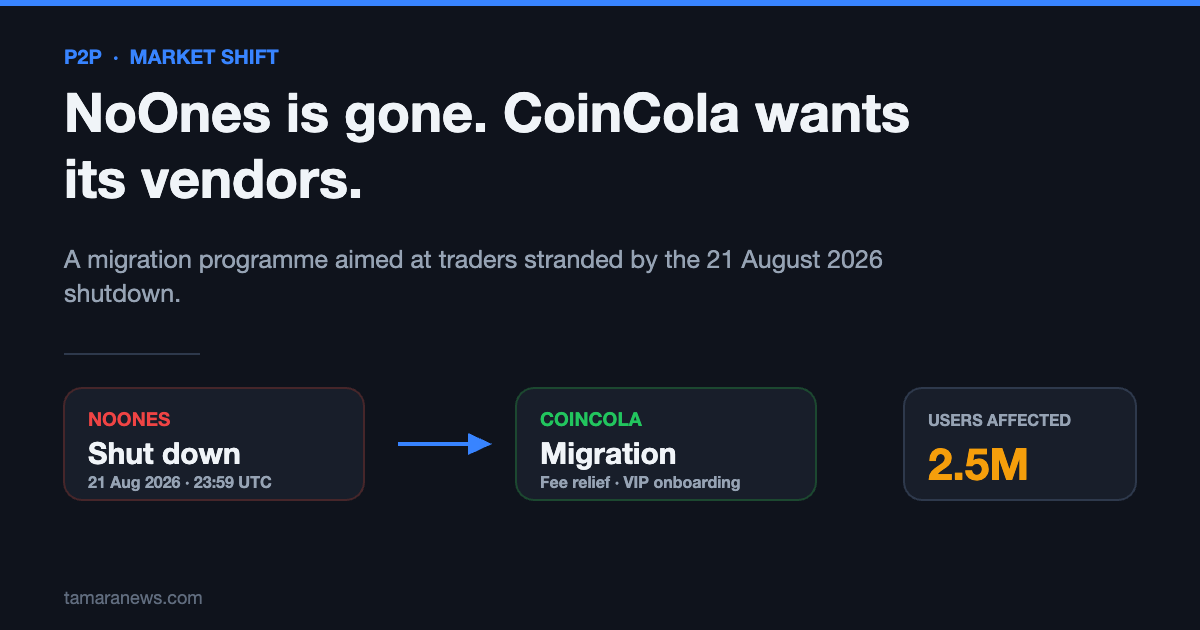
When NoOnes switched off its peer-to-peer marketplace on 21 August 2026, it did not just close a website. It stranded vendors who had spent years building reputation scores that existed nowhere else. The CoinCola migration program, announced this week, is an attempt to catch some of them before they drift to WhatsApp groups and Telegram channels where nobody holds the escrow.
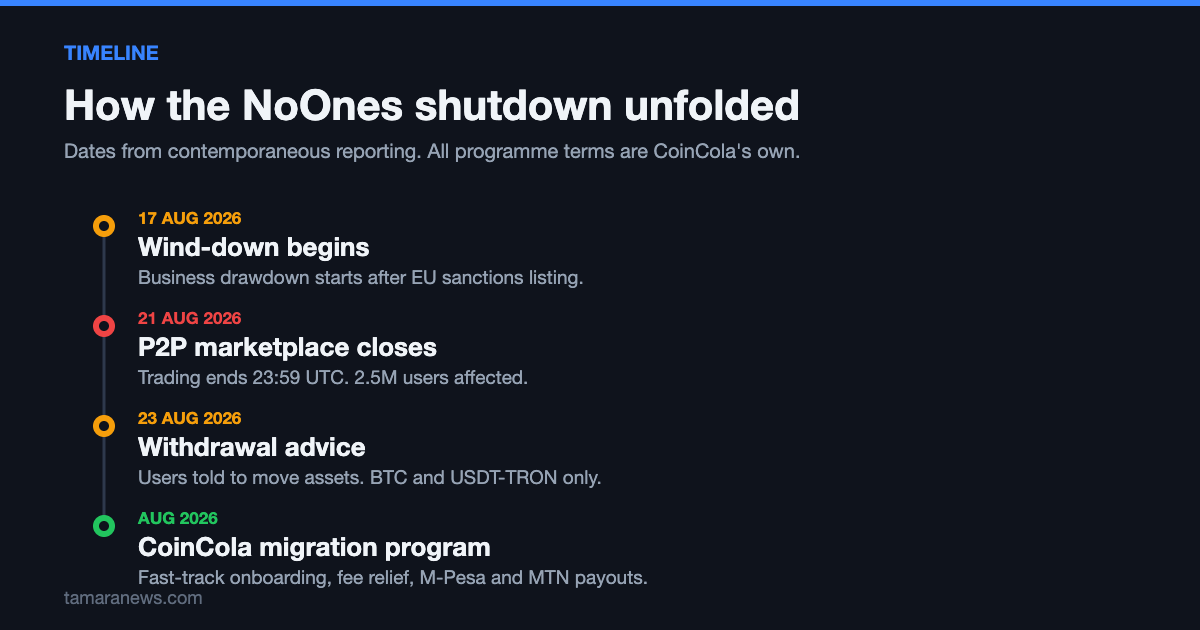
NoOnes had passed 2.5 million users earlier in 2026. The wind-down began on 17 August. The P2P marketplace closed at 23:59 UTC on 21 August, and the platform told users to pull their assets by 23 August. Withdrawals now run only over the Bitcoin network and Tether on TRON.
The cause was not a hack or a bank run. The EU added NoOnes to its Russia-related sanctions list. Partners cut ties, blockchain monitoring firms flagged the platform as high risk, and normal operations became impossible. We covered that collapse and what it meant for user funds in our earlier report on the NoOnes shutdown.
What the CoinCola migration program actually offers
CoinCola describes the package as a transition pathway for three groups: P2P vendors, gift card traders, and ordinary users who held balances. According to the company, it covers five areas.
- Fast-track vendor migration. Former NoOnes vendors can submit verifiable trading history. CoinCola says it will recognise eligible vendor reputation status and cut P2P fees for those who qualify.
- VIP onboarding. The company promises a dedicated account team, 24/7 priority dispute handling, and guidance on moving assets across.
- Mobile money payouts in Kenya and Ghana. CoinCola cites direct withdrawal integration with M-Pesa in Kenya, and MTN Mobile Money and Vodafone Cash in Ghana, with no extra deposit requirement.
- Gift card escrow. Multi-layer escrow, anti-fraud screening, and dedicated dispute handling on eligible gift card trades.
- Transition incentives. Fee discount vouchers and signup rewards aimed at traders working in Kenyan shillings and Ghanaian cedis.
Every one of those points comes from CoinCola. None has been independently verified, and the company has not published the eligibility thresholds, the size of the fee reduction, or how it will validate a trading history from a platform that no longer serves data.
Why reputation, not money, is the real loss
A P2P vendor’s balance is portable. Their reputation is not. Trade counts, completion rates, and dispute records sit inside one platform’s database. When that platform closes, a vendor with four years of history restarts at zero somewhere else.
That matters because reputation sets pricing power. Established vendors quote tighter spreads and attract larger orders precisely because buyers trust the badge. Strip it away and the vendor competes on price alone against strangers.
CoinCola says it identified three pressures on affected traders: keeping cash flow moving, preserving that track record, and avoiding unverified trades arranged over social channels. The third is the dangerous one. When a marketplace disappears, deals migrate to group chats, and group chats have no escrow.
“When a major marketplace halts trading, vendors risk losing both their working capital and the trading history they built over years,” said January, Content Manager at CoinCola.
The gift card corridor few outsiders track
Gift cards function as a remittance rail in several markets. A relative abroad buys a retail or digital card. The recipient sells it on a P2P marketplace and receives local currency. The money covers school fees, rent, or stock for a small business.
This corridor rarely appears in remittance statistics, because a gift card is not a wire transfer. It still moves real household income. NoOnes carried a meaningful share of that flow, which is why its closure reached further than its user count suggests.
What traders should check before migrating
An offer of continuity is appealing when your income has just stopped. It still deserves the same scrutiny you would apply to any platform holding your funds.
- Get the fee terms in writing. “Reduced P2P fees” is not a number. Ask what the rate becomes, and how long the reduction lasts.
- Test a small withdrawal first. Move a minor amount out before you move a large one. Confirm it lands, and note how long it takes.
- Check the licensing position. CoinCola does not hold a licence from a major financial regulator. Weigh that against platforms that do.
- Read the reviews yourself. CoinCola’s public review pages include complaints about frozen accounts and delayed withdrawals. Read them before you commit working capital.
- Keep your own records. Export whatever NoOnes history you still have. It is the only proof of your track record that you control.
Traders comparing options may also want to look at how signup incentives stack up, including CoinCola’s first naira trade bonus, before choosing where to rebuild.
What happens next
NoOnes has not said when withdrawal-only access ends. Anyone still holding a balance should move it now rather than wait for a deadline that may never be announced.
For CoinCola, the opportunity is obvious. A rival with millions of users has exited, and the vendors who supplied that liquidity are looking for somewhere to trade. Whether the promises in this programme survive contact with real volume is the part worth watching, and the part no press release can settle.
Eligible traders can review the terms on CoinCola’s NoOnes transition page. Reporting on the sanctions that forced the closure is available via CryptoSlate and BeInCrypto.
Frequently asked questions
When exactly did NoOnes shut down?
The wind-down started on 17 August 2026. The P2P marketplace closed at 23:59 UTC on 21 August 2026. NoOnes advised users to withdraw assets by 23 August 2026.
Why did NoOnes close?
The EU added the platform to its Russia-related sanctions list. Partners withdrew, monitoring firms classified it as high risk, and continued operation became unworkable.
Can I still withdraw funds from NoOnes?
Withdrawals run only over the Bitcoin network and Tether on TRON. NoOnes has not announced when that access ends, so move balances promptly.
Who qualifies for the CoinCola migration program?
CoinCola says former NoOnes vendors, gift card traders and P2P users qualify. Applicants with verified records of prior NoOnes volume go to a VIP queue. The company has not published exact thresholds.
Is CoinCola regulated?
CoinCola launched in 2017 and operates across Asia, Africa and Latin America. It does not hold a licence from a major financial regulator such as the SEC or FCA. Factor that into any decision.
Which mobile money services does the programme cover?
CoinCola lists M-Pesa in Kenya, plus MTN Mobile Money and Vodafone Cash in Ghana, with direct withdrawal and no additional deposit requirement.
Related Guides
- NoOnes Shutdown: What Happens to 2.5 Million Users’ Crypto Now
- CoinCola Is Paying New Nigerian Users ₦1,888 for Their First Naira Trade
Verification your users actually receive.
Send one-time passcodes over WhatsApp with a single API call. Replio can generate, hash and verify the code for you.
