
Never lose a customer to a missed message
An AI agent trained on your own business, replying in seconds, in any language, on every channel your customers already use.
Signup codes fail quietly. The message leaves your server, the gateway reports success, and the user still never types anything in. WhatsApp OTP vs SMS is the choice most teams make once, early, and never revisit. It is worth revisiting, because the two channels behave very differently once a code leaves your application.
This guide compares them on the things that decide whether a signup completes: how each one reaches the handset, what you learn afterwards, what the rules allow you to send, and what a single code costs.
WhatsApp OTP vs SMS: two very different delivery paths
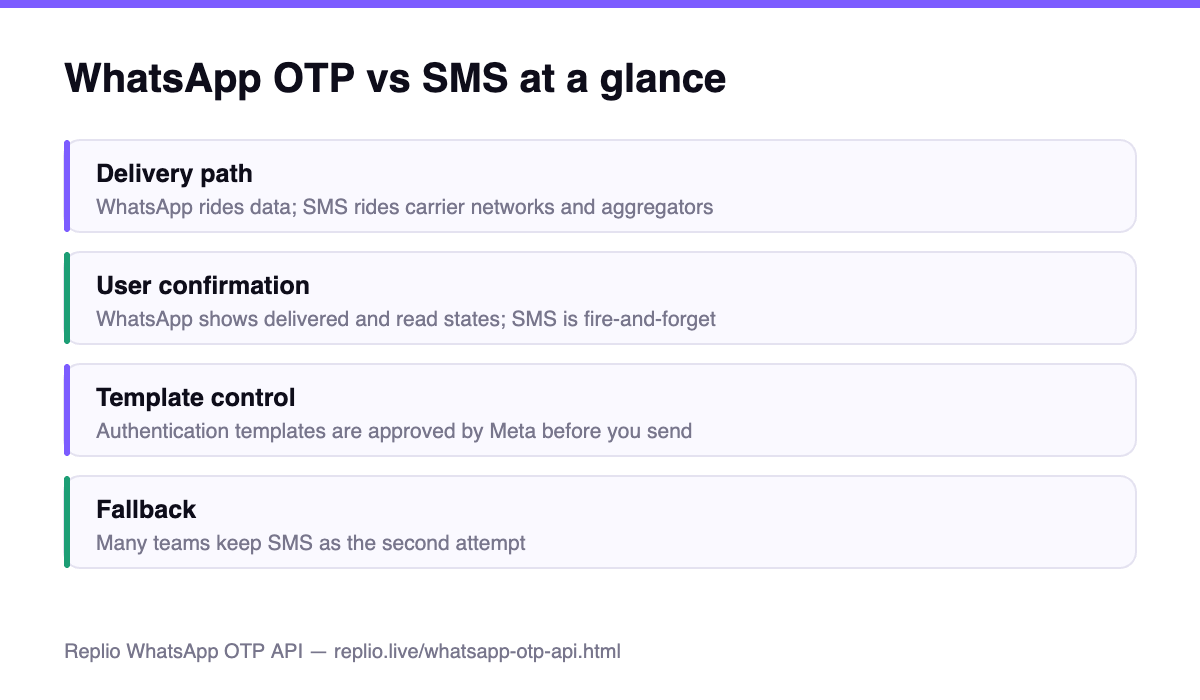
An SMS travels over carrier networks. It usually passes through an aggregator, then one or more carriers, before it reaches the handset. Each hop can filter, delay or silently drop it. You rarely find out which.
A WhatsApp message travels over the internet to Meta, then to the app on the device. There is no carrier in the middle. That removes a class of failure, and adds a different one: the recipient needs WhatsApp installed and online.
What SMS verification still does better
SMS reaches every phone. No app, no data plan, no account. For a service with older or low-connectivity users, that reach is hard to argue with.
SMS also needs no approval. You write the message and send it. WhatsApp does not work that way, which is the next section.
Where WhatsApp verification pulls ahead
Three things change in your favour.
- You learn what happened. WhatsApp reports delivered and read states. SMS is largely fire-and-forget, so a failed signup gives you nothing to debug.
- The code arrives from your business. Messages come from your verified number rather than a rotating shortcode, so the sender is recognisable.
- One-tap entry. Meta’s authentication templates support a copy-code button, which removes the retyping step where users fat-finger a digit.
There is a second-order effect worth naming. Because WhatsApp reports read receipts, a stalled signup stops being a mystery. You can see whether the code was delivered, whether it was opened, and whether the user simply abandoned the form. That turns a support guess into a measurable step you can fix.
The template rule that catches teams out
WhatsApp requires business-initiated messages to use a template Meta has approved in advance. For verification you want an Authentication category template. Meta ships a library of them, so most teams pick one rather than write their own.
Marketing templates are not a substitute. Sending a verification code on a marketing template sidesteps opt-out rules and is a common route to getting a number restricted. Providers reject it outright. Replio, for example, returns a template_not_allowed error rather than sending, per its published API reference.
What a verification code costs on each channel
SMS pricing varies by country and by aggregator, and it moves. WhatsApp conversation pricing is set by Meta and also varies by market. Neither channel is universally cheaper, so check your own corridors rather than trusting a blanket claim.
One structural difference is worth knowing. A few destinations cost noticeably more to reach on WhatsApp. Replio charges two credits instead of one for Indonesia, the United Arab Emirates and Malaysia, and returns the exact charge on every send. If your users concentrate in those markets, model it before you switch.
Choosing a default, and keeping a fallback
Most teams that move to WhatsApp do not delete SMS. They reorder it. WhatsApp becomes the first attempt, SMS becomes the retry when the first attempt fails.
That pattern handles the one genuine weakness. If a user has no WhatsApp account, the send fails with a clear error and your existing SMS path picks it up. The user notices nothing.
Whichever you pick, the security basics do not change. Generate codes from a cryptographically secure source, expire them in minutes rather than hours, and cap wrong guesses. If you would rather not own that logic, some providers generate and check the code for you and store only a hash of it.
Before you migrate anything
Run both channels side by side for a week on real signups. Compare completion rate, not delivery rate. Delivery tells you the message left; completion tells you the user actually got in.
If you are already using WhatsApp elsewhere in your business, the operational overhead is smaller than it looks. We covered how small teams handle WhatsApp and Instagram enquiries without working nights, and how the same channels are being used for customer service in Qatar.
Frequently asked questions
Is WhatsApp OTP more reliable than SMS?
Neither wins everywhere. WhatsApp removes carrier filtering and tells you when a code was delivered and read. SMS reaches handsets with no app and no data. Reliability depends on your users, not on the channel in the abstract.
Do I need Meta approval to send WhatsApp verification codes?
You need an approved template, not app review. Pick an Authentication template from Meta’s template library in WhatsApp Manager. Approval is usually quick because the wording is Meta’s own.
What happens if the user has no WhatsApp?
The send fails and returns an error. Treat that as the trigger for your SMS fallback rather than as a dead end.
Can I keep my existing verification logic?
Yes. Most WhatsApp OTP APIs let you pass a code you generated yourself and simply deliver it. Only omit the code if you want the provider to generate and verify it for you.
Does WhatsApp OTP replace SMS entirely?
Rarely, and it does not need to. The common production pattern is WhatsApp first, SMS as the automatic retry.
Related Guides
- The Verification Flow You Can Ship in an Afternoon (Node.js)
- 5 AI Customer Service Tools Qatar Businesses Actually Use in 2026
Verification your users actually receive.
Send one-time passcodes over WhatsApp with a single API call. Replio can generate, hash and verify the code for you.
