• Mon - Fri 9.00 - 19.00

Author Archives: Francisca Samuel

Author: Francisca Samuel

Francisca Samuel is an editor at Tamara News, where she covers immigration, travel, business and technology news for readers across Africa and the Gulf.

Meta Just Paid $12.1 Billion to Every State in America — Here’s Why

Meta will pay $12.1 billion to resolve claims from every US state attorney general. This Meta multistate settlement deal ranks among the largest state consumer protection settlements in American history, outside the 1990s tobacco cases, Delaware’s top prosecutor said. The deal was announced August 26, 2026. It is a separate matter from Meta’s $17 billion federal teen-safety trial settlement in Oakland, California, which landed the same week.

Two legal tracks. Two enormous numbers. Both landed in the same seven-day span. That coincidence has caused real confusion about which case is which, so the details matter here.

Meta multistate settlement deal

What the Meta multistate settlement deal actually covers

Delaware Attorney General Kathy Jennings led the announcement. But the settlement resolves claims from a coalition spanning all 50 states, several US territories and the District of Columbia. Delaware itself will collect $73.6 million over ten years. An $11 million installment arrives this year. Of that first payment, $4.2 million ties to the long-running Cambridge Analytica data scandal. State prosecutors kept pursuing that case for years after it first broke.

The settlement carries an unusual contingency clause. Meta will pay Delaware an extra $30 million if TikTok and YouTube reach their own settlements with the same coalition. Nationally, that contingency adds up to nearly $5 billion more. The clause ties Meta’s final payout to whether regulators can extract similar concessions from its biggest platform rivals.

How this differs from the Oakland federal trial settlement

This is not the $17 billion settlement Meta reached to end a federal trial in Oakland over teen social media addiction. That case also concluded around August 26, 2026. It produced court-ordered safety measures. Courts imposed usage limits for users under 18. They also restricted AI chatbot interactions with minors. The Delaware-led deal runs through state attorneys general instead of a federal court. Its remedies center on payments to states, not court-mandated product changes.

Two major legal tracks against one company in one week is unusual. It shows how many fronts have opened against major platforms over child safety in 2026. State AG coalitions, federal civil trials, and state legislatures are all moving at once.

Why states pursued Meta after years of complaints

State attorneys general built files on Meta’s platform design and data practices long before this settlement. Their claims range from the original Cambridge Analytica breach to newer complaints about engagement-driven features aimed at teenagers. A coalition this size rarely forms overnight. All 50 states plus territories typically join only after years of parallel investigations converge on the same underlying claims. That appears to be what happened here.

The size of the coalition also reflects a shift in how states approach Big Tech enforcement. A decade ago, state attorneys general mostly acted alone or in small regional groups. Coordinated 50-state actions like this one are now the norm for the largest platform companies, giving individual states more leverage than they would have negotiating separately.

What happens with the settlement money next

States start receiving payments under the ten-year schedule in 2026. Each state controls how it directs the funds once it receives them. The bigger open question is whether TikTok and YouTube negotiate their own settlements with the same coalition. If they do, Meta’s contingency clause kicks in. Its total payout would then climb by nearly $5 billion nationally. That gives Meta a clear financial reason to watch its rivals’ legal exposure closely in the coming months.

For now, Meta faces two separate sets of obligations from two separate August 2026 settlements. The Oakland case brings court-ordered product changes affecting how minors use its platforms. The Delaware-led deal brings a ten-year payment schedule to state governments. Meeting both sets of terms will be the real test of how seriously Meta treats this settlement wave, rather than the headline dollar figures alone.

Frequently asked questions

How big is the Meta multistate settlement deal?

Delaware Attorney General Kathy Jennings announced a $12.1 billion multistate settlement with Meta on August 26, 2026. It involves attorneys general from all 50 states, several territories and Washington, D.C.

How much does Delaware get from the settlement?

Delaware is guaranteed $73.6 million over ten years. An $11 million payment lands in 2026, including $4.2 million tied to the Cambridge Analytica scandal.

Is this the same case as Meta’s $17 billion Oakland trial settlement?

No. The Meta multistate settlement deal comes from state attorneys general. Meta’s Oakland federal trial settlement is a separate case that concluded around the same time.

What triggers Meta’s extra contingency payment?

Meta will pay Delaware an extra $30 million, and nearly $5 billion nationally, if TikTok and YouTube reach comparable settlements with the states over similar claims.

What did the settlement allege Meta did wrong?

The coalition’s claims centered on child safety and consumer protection issues tied to Meta’s platforms. They build on years of state-level investigations into features that affect young users.

How does this compare to other historic settlements?

Delaware’s attorney general called it one of the largest state consumer protection settlements in history outside the 1990s tobacco settlements. The scale of the 50-state coalition is what sets it apart.

Related coverage on Tamara News

Sources

This Central Asian Nation Just Won a UN Security Council Seat for the First Time Ever

Kyrgyzstan is heading to the UN Security Council for the first time in its history. It is one of five winners from the UN Security Council election held in June 2026. Their terms begin in January 2027. The vote used a secret ballot at UN headquarters. It reshapes the council’s rotating membership at a busy moment. The body faces pressure over Gaza, Ukraine, Sudan and Haiti, all at once.

Four of the five races were formalities. The fifth went to four rounds of voting. Kyrgyzstan edged out the Philippines for the Asia-Pacific seat.

UN Security Council election

How the UN Security Council election played out

The UN General Assembly filled five non-permanent seats on June 3, 2026. Each carries a two-year mandate starting January 1, 2027. The seats are split by region. One goes to Africa. One goes to Asia-Pacific. One goes to Latin America and the Caribbean. Two go to the Western European and Others Group, known as WEOG.

The council’s composition matters well beyond ceremony. Non-permanent seats give smaller and mid-sized states a temporary voice on the body that authorizes peacekeeping missions, approves sanctions regimes, and refers cases to international courts. Regional blocs coordinate for months, sometimes years, before an election to agree on a single endorsed candidate per seat. When that coordination breaks down, as it did this year in Asia-Pacific, the result is a genuine multi-round contest rather than a formality.

Zimbabwe and Trinidad and Tobago ran unopposed for the African and Latin American/Caribbean seats. Both won comfortably in the first round. Austria and Portugal took the two WEOG seats over Germany, also in round one. The only real contest was Asia-Pacific. Kyrgyzstan needed three extra rounds of secret balloting to beat the Philippines and reach the two-thirds majority required to win.

Why Kyrgyzstan’s seat is the headline result

Kyrgyzstan has never held a Security Council seat before. That makes this a genuine milestone for Central Asian representation at the UN’s most powerful body. Small and mid-sized states often campaign for years to build support for a contested seat. The Philippines is a far larger, more internationally active state. Kyrgyzstan’s win over it reflects sustained regional lobbying, not a routine outcome.

For the Philippines, the loss means another two-year wait for a seat it has held before. Manila has been vocal on South China Sea disputes lately. It would have valued a council platform right now.

What changes on the council starting January 2027

Five incoming members will join the council: Austria, Portugal, Trinidad and Tobago, Zimbabwe and Kyrgyzstan. They sit alongside five permanent, veto-holding members: the US, UK, France, Russia and China. Five other non-permanent members are still serving the second year of their own terms. None of the incoming five hold veto power. But non-permanent members still shape which resolutions get drafted and voted on. They also chair subsidiary committees that influence sanctions enforcement and peacekeeping mandates.

Austria and Portugal add two more European voices. The council is already weighted toward Western positions on Ukraine and Russia sanctions. Zimbabwe and Trinidad and Tobago bring African and Caribbean perspectives instead. Expect them to weigh in on Haiti’s security crisis and African Union peacekeeping funding.

What to watch before the new term begins

Outgoing non-permanent members will spend the rest of 2026 finishing committee work. They will also hand over council presidencies, which rotate monthly among all fifteen members. Expect the incoming five to start shadowing council sessions in late 2026 as they prepare to take their seats. Their first full council votes will likely come within weeks of the new term starting on January 1, 2027.

The outgoing members completing their terms at the end of 2026 have spent two years working on files ranging from Ukraine sanctions enforcement to peacekeeping mandates in Africa. Handover briefings between outgoing and incoming delegations typically happen informally throughout December, giving new members a head start before they cast their first formal vote in January.

Frequently asked questions

Which countries won the 2026 UN Security Council election?

Austria, Portugal, Trinidad and Tobago, Zimbabwe and Kyrgyzstan won the five available non-permanent seats. Their term covers 2027-28, according to Security Council Report.

When do the new members take their seats?

The newly elected members begin their two-year mandates on January 1, 2027. They replace the five non-permanent members whose terms expire at the end of 2026.

Was every seat contested?

No. Trinidad and Tobago and Zimbabwe ran unopposed. Austria, Germany and Portugal contested two Western European seats, and Kyrgyzstan beat the Philippines for the Asia-Pacific seat.

How many rounds of voting did the UN Security Council election take?

Austria, Portugal, Trinidad and Tobago and Zimbabwe won in the first round on June 3. The Asia-Pacific contest between Kyrgyzstan and the Philippines needed three more rounds.

Why does Kyrgyzstan’s win matter?

It is the first time Kyrgyzstan has ever held a UN Security Council seat. That gives Central Asia direct representation on the council for the first time this cycle.

Does winning a non-permanent seat give a country veto power?

No. Only five permanent members hold veto power: the US, UK, France, Russia and China. Non-permanent members serve two-year terms without veto rights.

Related coverage on Tamara News

Sources

The Man Running Trump’s Gaza Plan Just Turned on Israel

The Gaza ceasefire plan criticism from the official running its implementation is rare. Nikolay Mladenov briefed the UN Security Council on Wednesday. He said Israel’s continued strikes are undercutting a fragile process. He also warned that failure leaves only one alternative: another war. Mladenov is the Board of Peace’s high representative. He insisted the broader plan has not stalled.

His comments land at a delicate moment. Hamas has agreed to the plan’s central demand. That means disarmament and a handover of civilian governance. But Israeli military action has continued. It is straining a ceasefire meant to hold since last October.

Gaza ceasefire plan criticism

Mladenov’s Gaza ceasefire plan criticism, explained

Mladenov briefed the council in person. He said Trump’s 20-point plan has “moved from the negotiating table to the engineering table.” That means the framework is now in the harder phase of actual implementation. He also directly criticized Israel’s ongoing strikes. He argued they clash with a process meant to be winding down.

The criticism is notable for one reason. Mladenov’s job is to implement the US-backed framework, not referee Israeli-Palestinian tensions on his own. His willingness to publicly fault Israel says something. It shows how much strain the ceasefire is under, even months after it took hold.

Hamas disarmament and the plan’s core bargain

The plan’s trade is simple on paper. Hamas gives up its weapons. It hands administrative control of Gaza to a transitional, internationally backed authority. In exchange, Israeli military operations end and reconstruction can begin. Hamas has agreed to that bargain, per Mladenov’s briefing. That is a major concession from a group that ran Gaza for nearly two decades.

What remains unresolved is the pace of disarmament. Verification is also unresolved. So is whether Israel will scale back operations to match. Strikes have continued since October, at reduced intensity, but they are still killing Palestinians. That gap is exactly what Mladenov flagged to the council.

Verification is the hardest part of any disarmament deal. Outside monitors need a way to confirm weapons are actually surrendered, not just hidden or redistributed within Gaza. Past ceasefire and disarmament efforts in other conflicts have stalled at exactly this stage, when the political agreement is signed but the technical process of verifying compliance drags on for months. The Board of Peace has not yet detailed how it plans to verify Hamas’s disarmament on the ground.

Why Gazans still don’t feel the war has ended

For residents of Gaza, periodic strikes do not read as peace. Reporting from the territory describes a population still living with intermittent violence. Diplomats describe the framework as on track. That gap between narrative and lived experience is one of the plan’s biggest weaknesses. If Gazans conclude the ceasefire is nominal, pressure on Hamas to fully disarm weakens. The whole timeline then slips.

What happens if the plan stalls from here

Mladenov’s warning was blunt about the stakes. The alternative to the US plan succeeding is not the status quo. It is another war. That framing is meant to pressure everyone involved. Israel, Hamas, and the plan’s regional backers all face the same message: keep implementation moving, or risk losing it.

The plan’s next visible milestone should be a Security Council resolution. It would formalize the transitional governance structure and an international stabilization force for Gaza. No confirmed date has been set yet. Diplomats will watch two things in the coming weeks: whether Israeli strikes keep declining, and whether Hamas starts visible, verifiable disarmament steps.

Regional backers of the plan, including several Gulf states, have publicly welcomed the framework but have offered few specifics about their own role in funding reconstruction or contributing to a stabilization force. Their level of commitment will likely shape how quickly the plan can move from paper to practice on the ground in Gaza.

Frequently asked questions

Who criticized Israel over the Gaza ceasefire plan?

Nikolay Mladenov, the Board of Peace high representative overseeing implementation of the US-backed plan, told the UN Security Council that Israeli strikes since October’s ceasefire were undermining the process.

Has Hamas agreed to disarm under the plan?

Yes. Hamas has agreed to the plan’s key provision to disarm and hand civilian governance of Gaza to a transitional authority, according to Mladenov’s briefing.

Is the ceasefire still holding?

A ceasefire has been in effect since October, but Israeli strikes have continued at a reduced pace, and Gazans quoted in reporting say they do not feel the conflict has actually ended.

What happens if the Gaza ceasefire plan collapses?

Mladenov warned the Security Council that the alternative to the US plan succeeding is another war, framing the current diplomatic track as the only realistic route to a lasting peace.

What is the Board of Peace?

It is the oversight body created to implement President Trump’s 20-point Gaza plan, tasked with coordinating the shift from a negotiated framework to on-the-ground implementation, or what Mladenov called moving ‘from the negotiating table to the engineering table.’

Does the plan include a path to a Palestinian state?

The plan references a ‘credible pathway to a political horizon’ and a two-state solution, though officials have not published a detailed timeline for that phase.

Related coverage on Tamara News

Sources

47 Dead, 50 Taken: Inside Haiti’s Worst Gang Attack in Years

The Haiti gang kidnapping attack on the Kenscoff hills above Port-au-Prince has left 47 people dead. More than 50 residents were taken hostage. United Nations officials call it one of the largest mass kidnappings the country has seen in years. Gunmen struck the once-peaceful community on August 24, 2026. The assault shattered months of hard-won security gains. It renewed fears that Haiti’s capital region is slipping further from government control.

Kenscoff had been held up as a rare success story in Haiti’s fight against gang expansion. That reputation did not survive the weekend.

Haiti gang kidnapping attack

What happened in the Haiti gang kidnapping attack

Armed men swept into Kenscoff on Monday. They killed 47 residents and seized more than 50 others, the United Nations said. The assault came with little warning. Residents had almost no time to flee. The community sits in the hills above the wealthier Pétion-Ville district. Local reporting places the death toll among the highest recorded in a single gang raid in greater Port-au-Prince this year.

Video posted afterward showed a gang leader addressing Haiti’s national police director, Vladimir Paraison, directly. The message was blunt. If police or allied forces kill gang members while trying to free hostages, the hostages die too. That threat has frozen the immediate response. Any rescue operation now risks triggering mass killings.

Why gangs are targeting this part of Haiti now

Kenscoff is not a random target. Gangs already dominate much of central Port-au-Prince. They want the roads running through Kenscoff because those roads connect the capital to Haiti’s southern peninsula. Controlling those routes lets armed groups tax or block the movement of people, food and fuel. It also lets them pressure Pétion-Ville, one of the last relatively stable, wealthier districts in the metro area.

The irony is that Kenscoff had been getting safer. Security operations cut violence there by roughly two-thirds between January and August 2026. That progress made the community a visible counter-example to gang expansion. Officials now fear it became a target for that exact reason.

The hostage standoff and Haiti’s police response

Haiti’s National Police face a narrow set of options. A multinational security support mission backs them. A forced entry risks the hostages’ lives given the gang’s explicit threat. Negotiation risks legitimizing the group. It could also invite future mass-kidnapping tactics elsewhere. Neither option is fast. Residents of Kenscoff who were not taken remain in a community that no longer feels secure, regardless of how the standoff ends.

Haiti’s transitional government has not detailed a public timeline for resolving the standoff. Outside security assistance, including the UN-backed multinational mission, has struggled throughout 2026. It has not expanded fast enough to match gang territorial gains nationwide.

Haiti has lacked an elected president since 2021. A transitional council has governed since 2024, working alongside the multinational mission to try to restore basic security. Gangs are estimated to control most of Port-au-Prince already. Kenscoff’s fall would extend that control into one of the few districts that had pushed back successfully. That is part of why this single attack carries weight well beyond its immediate death toll.

Where the standoff goes from here

Analysts tracking Haiti expect one priority to come first: securing the hostages’ release, not a military assault on Kenscoff. Past mass-kidnapping cases in Haiti, including the 2025 orphanage seizure, ended through negotiated releases rather than raids. If that pattern holds, expect a slow, quiet process rather than a dramatic breakthrough.

The longer-term question is different. Does Kenscoff’s fall change the security calculus for Pétion-Ville and the rest of the capital? If gangs can now move freely along routes Kenscoff once blocked, aid delivery and civilian movement between Port-au-Prince and southern Haiti could get harder for months, not days.

Frequently asked questions

What happened in the Kenscoff attack?

Armed gunmen stormed the Kenscoff area above Port-au-Prince on August 24, 2026, killing 47 people and taking more than 50 residents hostage, according to United Nations officials cited by NPR.

Is this the largest kidnapping in Haiti’s recent history?

Officials describe it as one of the largest mass kidnappings in Haiti in recent years, though Haiti has seen large-scale abductions before, including a 2025 orphanage kidnapping.

Why did the gang attack Kenscoff specifically?

Kenscoff sits above the upscale Pétion-Ville district and controls alternate routes linking Port-au-Prince to southern Haiti, making it strategically valuable to gangs seeking to encircle the capital.

What is the gang threatening to do to the hostages?

A gang leader posted a video warning Haiti’s police director, Vladimir Paraison, that hostages would be killed if security forces harmed any gang members during operations to retake the area.

Had security in Kenscoff been improving before the attack?

Yes. Security operations reportedly cut violence in Kenscoff by 66% between January and August 2026, which is part of why the scale of this attack alarmed officials.

Is it safe to travel to Haiti right now?

Multiple governments maintain do-not-travel advisories for Haiti given ongoing gang violence; travelers should check official advisories before any trip and avoid areas near active security operations.

Related coverage on Tamara News

Sources

Hamad Airport to Doha: Four Routes, Four Very Different Bills

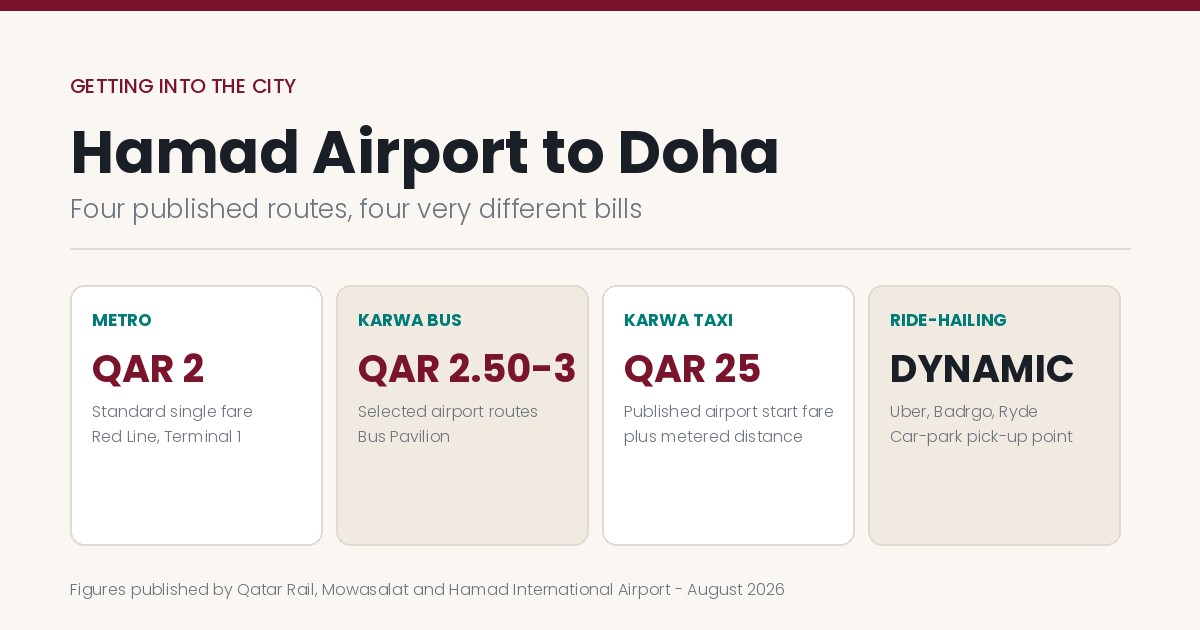
Four routes lead out of Hamad International Airport into the city, and their published prices are nowhere near each other. The lowest single fare on the list is QAR 2. One option has no fixed price at all. Getting from Hamad Airport to Doha is straightforward either way. The real questions are what you pay, where you board, and whether your chosen service is even running when you land.

This guide sets out what each operator publishes. The figures come from Qatar Rail, Mowasalat and the airport’s own ground-transport pages, checked on 29 August 2026. Fares change, so confirm the current number before you travel.

Hamad Airport to Doha by Metro: the QAR 2 route

The airport has its own Red Line station, Hamad International Airport Terminal 1. The airport describes it as a short indoor walk from the terminal. Trains run seven days a week.

Standard class costs QAR 2 for a single journey. Your spending caps at QAR 6 for the day once you make a third trip. A reusable Standard Travel Card costs QAR 10 before you add credit. Goldclub travellers pay QAR 100 for the card and QAR 30 for a day pass. Published figures for the single Goldclub journey differ between sources, so read the fare screen at the vending machine.

Children under five travel free. Older children pay the adult fare.

The Red Line covers 40 km from Al Wakra in the south to Lusail in the north across 18 active stations, according to Visit Qatar. Trains arrive roughly every six minutes. The average hop between stations takes about three minutes. Msheireb is the main interchange, where the Red, Green and Gold lines all meet.

One catch matters more than the fare. The Metro does not run around the clock, and Friday morning services pause for prayers. Check the last-train display before you commit, especially on a late arrival.

The Karwa taxi from Hamad Airport to Doha

Mowasalat operates every taxi at the airport. Arriving passengers board at the Taxi Pavilion, at the left end of the Arrivals Hall. Sedans and vans both wait there, and taxi coordinators help with luggage.

Published fare information continues to list QAR 25 as the airport starting fare. Widely reported distance rates run to roughly QAR 1.60 per kilometre by day and QAR 1.90 per kilometre at night or outside Doha. Mowasalat’s current public taxi page does not publish the full tariff table, so treat those per-kilometre figures as reported rather than confirmed. Our companion guide to Karwa taxi fares in Qatar works through which numbers the operator itself confirms.

A trip into central Doha commonly lands somewhere around QAR 40 to QAR 60. Treat that as a planning estimate rather than a fixed airport rate. Traffic, waiting time and your exact address all move the meter.

Airport taxis accept Mastercard, Visa, Apple Pay, Google Pay and NAPS, according to Hamad International Airport. You can book ahead on +974 800 8294 or through the Karwa app. Passengers who need a vehicle for reduced mobility should call Mowasalat on +974 4458 8888 with as much notice as possible.

The airport advises boarding only at the Taxi Pavilion. Drivers there work to set performance standards and a documented lost-and-found policy.

Ride-hailing from Hamad Airport to Doha: who can collect you

Qatar’s Ministry of Transport licenses seven ride-hailing operators nationally: Uber, badrgo, Aabir, Karwa, Ryde, EzGo and wer2 GO. Our roundup of the leading ride-hailing apps in Qatar covers what each platform offers.

Airport pickup runs on a narrower list. Hamad International Airport currently names Uber, Badrgo and Ryde as its operational ride-hailing providers. A national licence does not by itself grant airport pickup rights. Check your app before you count on it.

The pickup point sits inside the multi-level car park rather than outside Arrivals. The airport’s own directions read: leave the Arrivals Hall through Gate 3, cross the service roads, enter the car park directly ahead, turn left and then right in front of the escalators, then walk out through the automatic sliding doors. Signage marks the route and staff can point the way.

App prices move with demand, vehicle class and traffic. Read the live quote before you confirm the booking.

Karwa buses from the airport into Doha districts

Mowasalat also runs public buses out of the airport. They leave from the Bus Pavilion, to the right of the Arrivals Hall, and carry luggage space.

Current airport routes include 757 to Mansoura, L533 to Al Thumama, T612 to the Industrial Area Bus Station, T613 to Mesaieed, and M316 linking Ras Bu Abboud Metro Station. Published route maps show QAR 3 for L533 and QAR 2.50 to QAR 3 for T612. Both routes list 24-hour operation.

One warning saves a lot of confusion. Metro travel and Karwa bus travel use separate payment systems. A Qatar Rail Travel Card will not pay your bus fare.

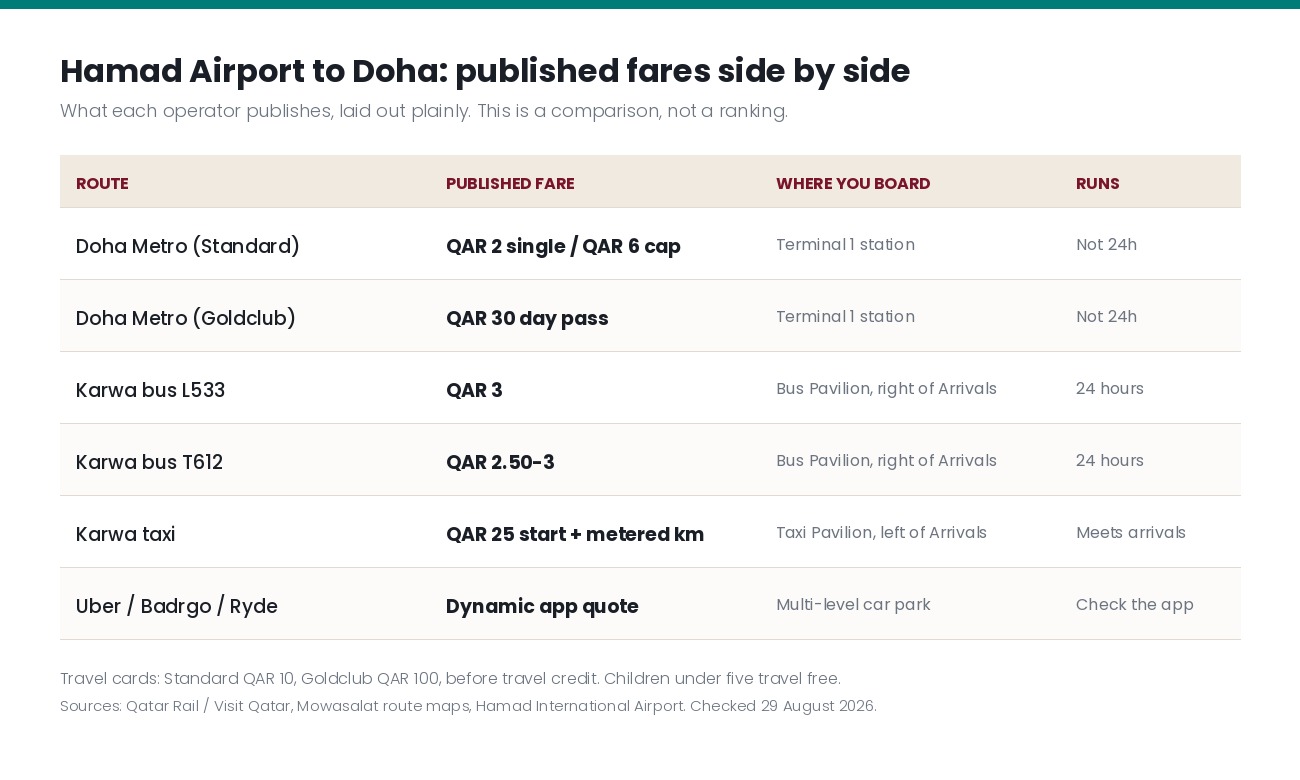
Table comparing Hamad Airport to Doha published fares, boarding points and operating hours
Published fares for each route from Hamad Airport to Doha, compared side by side.

Hamad Airport to Doha: the published fares compared

The table above sets the published figures beside each other. Four things it cannot show:

  • The QAR 2 Metro fare only carries you to a station. Budget for a taxi at the far end if your hotel sits a long walk away.
  • A first-time Metro rider also buys the QAR 10 card, so the real first-trip outlay is QAR 12.
  • Group size flips the arithmetic. Four passengers on the Metro pay QAR 8 between them. One taxi carries all four on a single metered fare.
  • Travel guides commonly quote roughly 25 minutes for the airport-to-Msheireb run, though live conditions decide the actual time.

Sort this out before you leave the terminal

Pick your route while you wait at baggage reclaim. Three quick checks head off most problems.

Check the last train if you land late at night. Check that your ride-hailing app currently serves the airport. Check the walking distance from your destination station to the actual door, because “near the Metro” can still mean fifteen minutes with a suitcase.

Planning a wider Gulf trip? Our guide to the GCC unified tourist visa covers the entry side of the same journey.

Hamad Airport to Doha: your questions answered

What is the cheapest published fare from the airport into the city?

The Doha Metro lists a QAR 2 Standard single journey, the lowest published single fare among the four routes covered here. Selected Karwa buses list QAR 2.50 to QAR 3.

How much does a taxi cost from the airport to central Doha?

Budget roughly QAR 40 to QAR 60 for central districts. Published fare information lists QAR 25 as the airport starting fare, with metered distance and waiting charges added on top.

Is Uber available at Hamad International Airport?

Yes. The airport currently lists Uber, Badrgo and Ryde as operational ride-hailing providers. All three collect from the designated point inside the multi-level car park.

Does the Metro run all night?

No. The Doha Metro operates seven days a week but not around the clock, and Friday morning services pause for prayers. Station displays show the current last-train times.

Can one card pay for both the Metro and a Karwa bus?

No. Qatar Rail Travel Cards cover the Metro and Lusail Tram. Karwa public buses use a separate payment system.

How long does the Metro take from the airport into the centre?

Travel guides commonly quote roughly 25 minutes to Msheireb. Trains arrive about every six minutes and average around three minutes between stations.

Sources

Related Guides