
Wall Street Is Watching One Speech for Clues on September Rates

The Jackson Hole economic symposium opened on August 27, 2026, in Wyoming. Investors are parsing every word for hints about where US interest rates go next. This year’s gathering, hosted by the Federal Reserve Bank of Kansas City, carries extra weight. It is the first edition under new Fed Chair Kevin Warsh, who took over the role in May 2026.

The three-day event runs through August 29. Organizers set this year’s theme as “Financial Innovation: Implications for Payments and Policy.” It brings together central bankers, academics and market economists from around the world. The symposium itself makes no policy decisions. But remarks from sitting Fed chairs have repeatedly moved bond and equity markets in the past. That history is why this year’s speeches are drawing outsized attention.

What the Jackson Hole economic symposium is

The Kansas City Fed has hosted the symposium since 1978. It has become one of the most closely watched fixtures on the global economic calendar. Central bank governors, finance ministers and leading academic economists present research there. They also hold closed-door discussions on the year’s defining monetary policy questions. In past years, symposium speeches previewed major shifts in Fed thinking well before those shifts showed up in official policy statements.

Wyoming mountain conference setting for the Jackson Hole economic symposium

A new Fed chair’s first turn at the podium

Markets are watching Kevin Warsh’s appearance at this year’s symposium closely. It gives investors a chance to get a clearer read on his approach after just a few months in the role. Warsh takes over at a moment when the Fed faces competing pressures. Inflation still runs above target in several major economies. And Fed officials disagree internally over whether the next move should be a cut, or, as some Federal Open Market Committee members argue, a further hike.

Why this year’s theme is financial innovation and payments

Organizers chose “Financial Innovation: Implications for Payments and Policy” as the 2026 theme. That choice reflects how central banks globally are grappling with faster payment rails, stablecoins and central bank digital currencies. Sessions this year cover how these innovations affect monetary policy transmission and financial stability. They sit alongside the more traditional focus on growth, employment and inflation.

What markets are pricing in for September

The Fed left its target range unchanged at 3.50% to 3.75% at its late-July meeting. Three Federal Open Market Committee members dissented in favor of a 25 basis point increase, which underscores how divided the committee is. US inflation has stayed more than a percentage point above the Fed’s 2% target for over five years. That gap keeps alive a scenario where the Fed’s next move goes up, not down. Traders are watching Jackson Hole speeches for any signal on how that debate is shifting ahead of the Fed’s mid-September meeting.

What happens next after Jackson Hole

Once the symposium wraps on August 29, attention shifts fast to incoming jobs and inflation data. That data will land before the Fed’s September meeting. Analysts expect to parse Warsh’s remarks sentence by sentence in the days after the event, much as they have done with past chairs’ Jackson Hole speeches.

Jackson Hole 2026: quick answers for investors

What is the Jackson Hole symposium? An annual Kansas City Fed-hosted conference where central bankers and economists discuss major monetary policy issues.

When is it happening this year? August 27-29, 2026, themed “Financial Innovation: Implications for Payments and Policy.”

Who is the Fed chair this year? Kevin Warsh, who became Fed chair in May 2026; this is his first Jackson Hole appearance in the role.

Did the Fed raise or cut rates in August? Neither. There was no scheduled Fed meeting in August; rates stayed at 3.50%-3.75% from the late-July decision.

Why does the market care so much about this event? Past Fed chairs have used Jackson Hole speeches to signal policy shifts ahead of the next scheduled meeting.

When is the next Fed rate decision? Mid-September 2026.

For related coverage, see our reporting on the Fed’s July rate hold and the Bank of England’s own rate decision.

Sources: Federal Reserve Bank of Kansas City, Federal Reserve Board.

Meta Agreed to Pay $17 Billion — Here’s What Teens Get

The Meta teen safety settlement closes out one of the largest legal fights the company has faced over how Facebook and Instagram treat young users. Meta agreed on August 26, 2026, to pay $17 billion. The company also agreed to a specific list of safety features. Those changes end a landmark trial brought by 47 states over teen social media addiction.

The case traces back to 2023, when 33 states sued Meta. The list included California, Virginia, Indiana, Kentucky and New Jersey. States accused Meta of knowingly building addictive features into its platforms. They said Meta kept internal research about the harm to minors out of public view. That case grew into a 47-state settlement. It covers some of the most sweeping product changes Meta has ever agreed to for teenage users.

Inside the Meta teen safety settlement

The $17 billion figure ranks among the largest settlements ever reached in a case tied to platform design. Most such cases involve a single product defect instead. Court filings describe the payment as covering direct compensation tied to the states’ claims. Some funding is earmarked for youth mental health programs. The exact allocation was still being finalized when the settlement was announced.

Courthouse steps representing the Meta teen safety settlement legal case

What 47 states accused Meta of doing

The states argued that Meta built features to maximize time spent on the platform by minors. Those features included infinite scroll, algorithmic recommendation feeds and visible engagement metrics such as like counts. The states said Meta knew about links to anxiety, poor sleep and body-image harm. Meta had previously pointed to its existing parental controls and argued that families bear responsibility for screen time. The company did not admit wrongdoing as part of the settlement.

New limits on Instagram and Facebook for under-18 users

Meta agreed to a defined package of safety measures under the deal. Users under 18 will face a default two-hour daily time limit on Instagram and Facebook. An overnight block will run from midnight to 6 a.m. Push notifications will switch off during weekday school hours. Meta also agreed to strengthen age-assurance technology to identify underage users more reliably. The company will add age-appropriate content controls for bullying and self-harm material. It will build more usable parental controls too. And it will limit features tied to social comparison, including visible like counts.

How this settlement compares to past tech accountability fights

Tech platforms have faced fines before over data privacy and antitrust issues. Design-focused cases like this one are harder to win. They hinge on proving intent behind product features, not a single rule violation. This settlement is unusually large. It also forces specific, measurable product changes rather than just a payment. Together, those two facts mark a shift in how these design-liability cases get resolved. The case follows a broader wave of litigation this year accusing major platforms of building addictive features for minors.

What happens next for enforcement

The settlement puts the burden on Meta to implement the agreed changes. State attorneys general involved in the case plan to monitor compliance. The case ended in settlement rather than a final court judgment. That means some granular technical requirements, including exact age-verification methods, will likely get worked out in follow-up filings over the coming months.

Meta settlement: the details parents are asking about

How much is Meta paying? $17 billion, to resolve claims brought by 47 states.

Which states sued Meta? The case began with 33 states in 2023, including California, Virginia, Indiana, Kentucky and New Jersey, and grew to 47 states in the final settlement.

What changes are coming to Instagram and Facebook? A default two-hour daily limit and overnight block for under-18 users, no school-hours notifications, stronger age checks, and limits on features like visible like counts.

When do these changes start? Meta is expected to roll them out on a defined schedule following the settlement; exact dates for each feature were still being finalized in late August.

Does this end all lawsuits against Meta? It resolves the state-led case that went to trial, but separate private lawsuits and claims elsewhere may continue.

Did Meta admit wrongdoing? No. The company agreed to the payment and the product changes without admitting the states’ claims.

For related coverage, see our earlier reporting on social media addiction lawsuits against Meta and Google and our piece on how small businesses use WhatsApp and Instagram.

Sources: MPR News, US News.

NoOnes Took 2.5 Million Traders Offline. CoinCola Wants Them Back

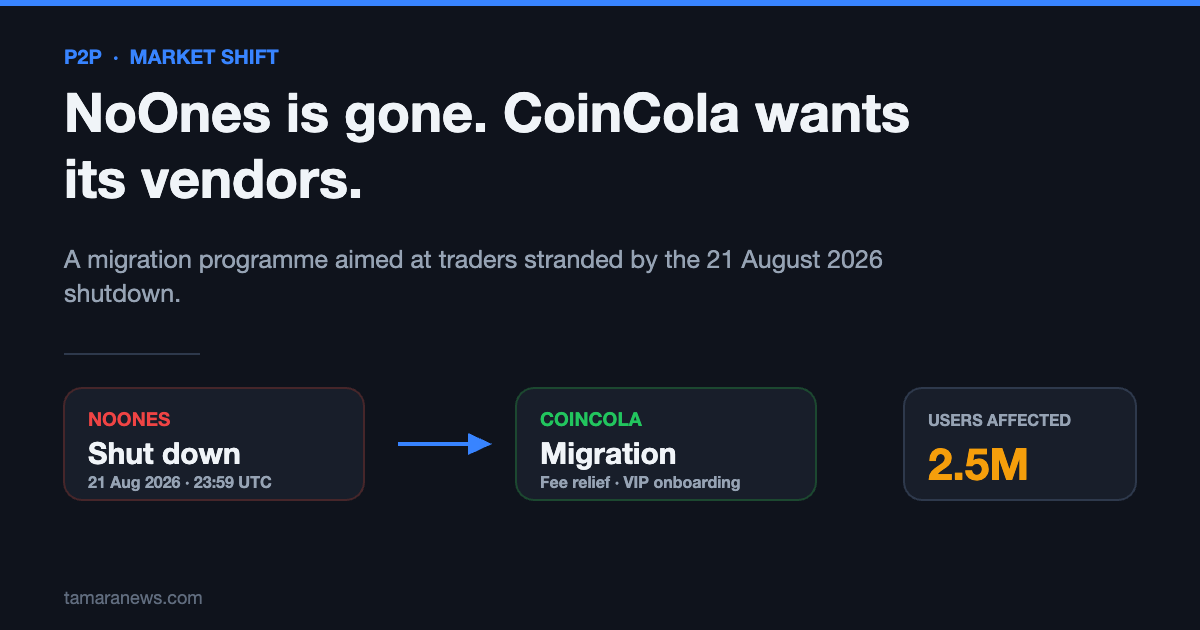
When NoOnes switched off its peer-to-peer marketplace on 21 August 2026, it did not just close a website. It stranded vendors who had spent years building reputation scores that existed nowhere else. The CoinCola migration program, announced this week, is an attempt to catch some of them before they drift to WhatsApp groups and Telegram channels where nobody holds the escrow.

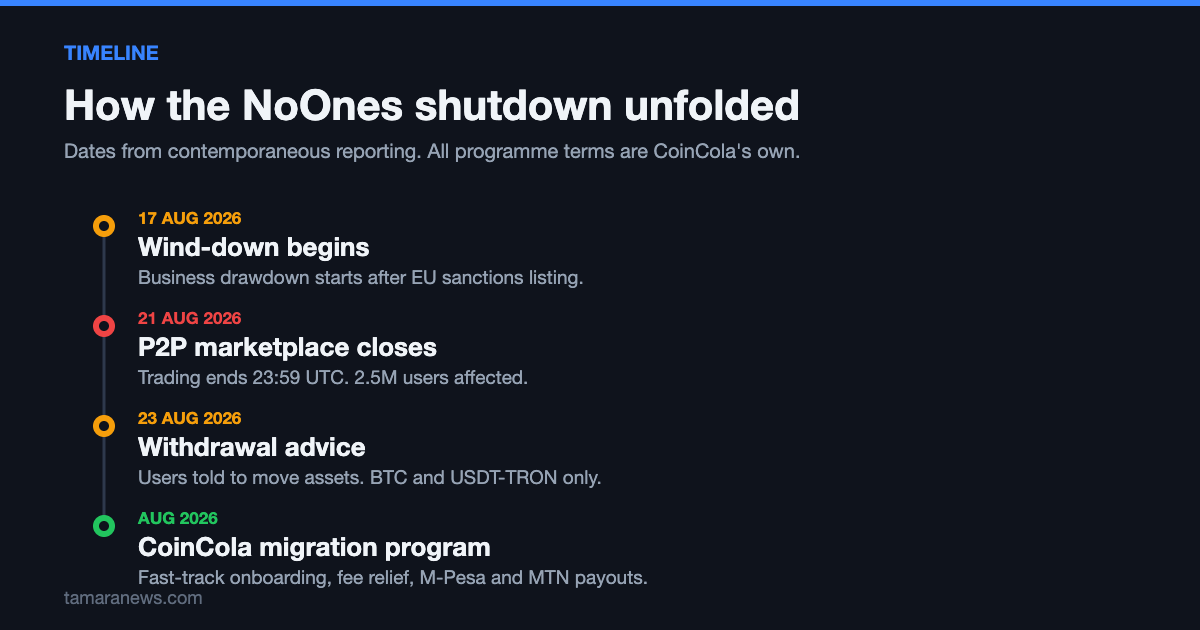
NoOnes had passed 2.5 million users earlier in 2026. The wind-down began on 17 August. The P2P marketplace closed at 23:59 UTC on 21 August, and the platform told users to pull their assets by 23 August. Withdrawals now run only over the Bitcoin network and Tether on TRON.

The cause was not a hack or a bank run. The EU added NoOnes to its Russia-related sanctions list. Partners cut ties, blockchain monitoring firms flagged the platform as high risk, and normal operations became impossible. We covered that collapse and what it meant for user funds in our earlier report on the NoOnes shutdown.

Timeline of the NoOnes shutdown leading to the CoinCola migration program, from 17 to 23 August 2026
The NoOnes wind-down ran over six days in August 2026.

What the CoinCola migration program actually offers

CoinCola describes the package as a transition pathway for three groups: P2P vendors, gift card traders, and ordinary users who held balances. According to the company, it covers five areas.

  • Fast-track vendor migration. Former NoOnes vendors can submit verifiable trading history. CoinCola says it will recognise eligible vendor reputation status and cut P2P fees for those who qualify.
  • VIP onboarding. The company promises a dedicated account team, 24/7 priority dispute handling, and guidance on moving assets across.
  • Mobile money payouts in Kenya and Ghana. CoinCola cites direct withdrawal integration with M-Pesa in Kenya, and MTN Mobile Money and Vodafone Cash in Ghana, with no extra deposit requirement.
  • Gift card escrow. Multi-layer escrow, anti-fraud screening, and dedicated dispute handling on eligible gift card trades.
  • Transition incentives. Fee discount vouchers and signup rewards aimed at traders working in Kenyan shillings and Ghanaian cedis.

Every one of those points comes from CoinCola. None has been independently verified, and the company has not published the eligibility thresholds, the size of the fee reduction, or how it will validate a trading history from a platform that no longer serves data.

Why reputation, not money, is the real loss

A P2P vendor’s balance is portable. Their reputation is not. Trade counts, completion rates, and dispute records sit inside one platform’s database. When that platform closes, a vendor with four years of history restarts at zero somewhere else.

That matters because reputation sets pricing power. Established vendors quote tighter spreads and attract larger orders precisely because buyers trust the badge. Strip it away and the vendor competes on price alone against strangers.

CoinCola says it identified three pressures on affected traders: keeping cash flow moving, preserving that track record, and avoiding unverified trades arranged over social channels. The third is the dangerous one. When a marketplace disappears, deals migrate to group chats, and group chats have no escrow.

“When a major marketplace halts trading, vendors risk losing both their working capital and the trading history they built over years,” said January, Content Manager at CoinCola.

The gift card corridor few outsiders track

Gift cards function as a remittance rail in several markets. A relative abroad buys a retail or digital card. The recipient sells it on a P2P marketplace and receives local currency. The money covers school fees, rent, or stock for a small business.

This corridor rarely appears in remittance statistics, because a gift card is not a wire transfer. It still moves real household income. NoOnes carried a meaningful share of that flow, which is why its closure reached further than its user count suggests.

What traders should check before migrating

An offer of continuity is appealing when your income has just stopped. It still deserves the same scrutiny you would apply to any platform holding your funds.

  • Get the fee terms in writing. “Reduced P2P fees” is not a number. Ask what the rate becomes, and how long the reduction lasts.
  • Test a small withdrawal first. Move a minor amount out before you move a large one. Confirm it lands, and note how long it takes.
  • Check the licensing position. CoinCola does not hold a licence from a major financial regulator. Weigh that against platforms that do.
  • Read the reviews yourself. CoinCola’s public review pages include complaints about frozen accounts and delayed withdrawals. Read them before you commit working capital.
  • Keep your own records. Export whatever NoOnes history you still have. It is the only proof of your track record that you control.

Traders comparing options may also want to look at how signup incentives stack up, including CoinCola’s first naira trade bonus, before choosing where to rebuild.

What happens next

NoOnes has not said when withdrawal-only access ends. Anyone still holding a balance should move it now rather than wait for a deadline that may never be announced.

For CoinCola, the opportunity is obvious. A rival with millions of users has exited, and the vendors who supplied that liquidity are looking for somewhere to trade. Whether the promises in this programme survive contact with real volume is the part worth watching, and the part no press release can settle.

Eligible traders can review the terms on CoinCola’s NoOnes transition page. Reporting on the sanctions that forced the closure is available via CryptoSlate and BeInCrypto.

Frequently asked questions

When exactly did NoOnes shut down?

The wind-down started on 17 August 2026. The P2P marketplace closed at 23:59 UTC on 21 August 2026. NoOnes advised users to withdraw assets by 23 August 2026.

Why did NoOnes close?

The EU added the platform to its Russia-related sanctions list. Partners withdrew, monitoring firms classified it as high risk, and continued operation became unworkable.

Can I still withdraw funds from NoOnes?

Withdrawals run only over the Bitcoin network and Tether on TRON. NoOnes has not announced when that access ends, so move balances promptly.

Who qualifies for the CoinCola migration program?

CoinCola says former NoOnes vendors, gift card traders and P2P users qualify. Applicants with verified records of prior NoOnes volume go to a VIP queue. The company has not published exact thresholds.

Is CoinCola regulated?

CoinCola launched in 2017 and operates across Asia, Africa and Latin America. It does not hold a licence from a major financial regulator such as the SEC or FCA. Factor that into any decision.

Which mobile money services does the programme cover?

CoinCola lists M-Pesa in Kenya, plus MTN Mobile Money and Vodafone Cash in Ghana, with direct withdrawal and no additional deposit requirement.

Related Guides

A Credit Union Tech Vendor Went Dark a Month Ago — Now It’s Facing 14 Lawsuits

TruStage sells financial-services products that touch roughly 42 million consumer relationships. More than a month ago, the company shut down parts of its own network to contain a cyberattack. It still hasn’t said what data, if any, intruders took. The TruStage outage class actions have piled up fast: a Wisconsin federal court had logged 14 separate suits by late July. All of them trace back to a single cybersecurity incident. TruStage first disclosed it on July 15. The incident knocked out services credit unions rely on every day, including member access to 401(k) accounts.

What took TruStage’s systems offline

TruStage disclosed the cybersecurity incident on July 15, 2026. The company said unauthorized third parties likely accessed its systems. TruStage then shut down its own network to contain the intrusion — a move that disrupted services credit unions depend on daily.

Cybersecurity data breach illustration relevant to the TruStage outage class actions

Inside the TruStage outage class actions piling up in Wisconsin

A July 29 court order counted 13 class actions filed against TruStage in a single Wisconsin federal court since July 17. A 14th arrived the same day. Bessemer System Federal Credit Union filed one of the suits. It alleges TruStage failed to implement and maintain adequate, industry-standard cybersecurity safeguards. Separately, a California resident who banks at one of TruStage’s credit-union clients filed the first individual consumer class action, Brown v. TruStage Financial Group, on July 23 in the Western District of Wisconsin.

What credit union members actually lost access to

TruStage says it protects 42 million consumer relationships. When its network went offline, credit unions that rely on TruStage lost member-facing services. Some members got locked out of accounts, including 401(k) plans.

Why one vendor going dark hits so many credit unions at once

The episode exposed just how concentrated the credit union technology supply chain has become. A single vendor outage at TruStage disrupted institutions and members nationwide, not just one company’s own customers. That concentration risk now sits at the center of several lawsuits. Plaintiffs argue that credit unions and their members had little visibility into, or control over, the vendor’s own security practices. Smaller credit unions often lean on a handful of shared vendors for core services. Building that infrastructure in-house costs far more than most small institutions can justify. That’s part of why one incident like this can ripple so widely across the sector. It took an outage of this scale, and the wave of lawsuits that followed, to draw broad public attention to how concentrated that vendor dependence really is.

What TruStage still hasn’t said

As of publication, TruStage hasn’t confirmed whether intruders accessed or took personal or member data. The company also hasn’t disclosed how its systems were compromised, when the incident actually began, or whether ransomware was involved. That silence sits at the center of several complaints in the lawsuits now filed against it.

What happens next in court

More than a dozen suits have already landed in the same Wisconsin court, so consolidation looks like a likely next step. Plaintiffs are seeking damages, recovery of payments made for what they call deficient services, reimbursement of breach-related expenses, and declaratory and equitable relief. More suits could follow as credit unions and members keep assessing how the monthslong outage affected them.

Why members are hearing about this from their own credit union first

TruStage does not have a direct relationship with most of the consumers affected by the outage. Its customers are the credit unions themselves, not individual account holders. That structure means most affected members learned about service disruptions through their own credit union, not directly from TruStage. Several of the lawsuits argue this left everyday members with little insight. Members often couldn’t tell which vendor actually caused the problems they experienced.

TruStage lawsuits: what members are asking

What is TruStage?

A financial-services vendor that supports credit unions. The company says its products touch roughly 42 million consumer relationships.

When did the TruStage outage start?

TruStage disclosed the cybersecurity incident on July 15, 2026, and the disruption has continued for more than a month since.

How many lawsuits has TruStage faced?

At least 14 separate class actions, according to a July 29 court filing in a Wisconsin federal court.

Has TruStage confirmed a data breach?

No. As of publication, TruStage hasn’t said whether intruders accessed or took personal or member data.

Are credit union members’ funds at risk?

No report has confirmed stolen funds. The disruption has centered on access to services and accounts, including 401(k) plans.

What should affected credit union members do?

Monitor account activity and watch for official communication from their own credit union, since guidance may vary by institution.

What to watch as the litigation moves forward

Court filings in the coming weeks should clarify whether the various suits get formally consolidated into a single case. Consolidation is common when many plaintiffs raise similar claims against one defendant. Discovery, if the case proceeds that far, would likely force TruStage to disclose more detail than it has shared publicly so far. Credit unions and members alike are waiting for that clarity. Only then can they assess how much the incident ultimately cost them.

Related coverage on Tamara News

Nvidia Reports Earnings Today — Here’s the Number That Could Move the Whole Market

Nvidia reports fiscal 2027 second-quarter results after markets close today. Investors call it the most closely watched Nvidia earnings report today of the year. Wall Street expects revenue near $92.2 billion, up roughly 97% from a year earlier. Analysts forecast earnings of about $2.09 a share — nearly double what Nvidia posted in the same quarter last year. Nvidia’s own guidance, issued in May, pointed to revenue of $91 billion, plus or minus 2%. Nvidia’s chips sit at the center of the AI buildout. That’s why investors read today’s numbers as a referendum on the entire AI trade, not just one company’s quarter.

Why Nvidia earnings report today matters beyond Nvidia

Nvidia’s results ripple through chipmakers, cloud providers and other AI-linked stocks. So much of the current data-center spending boom runs through Nvidia’s GPUs. A beat or a miss today tends to move sentiment across the whole sector, not just Nvidia’s own share price.

Semiconductor chip factory floor, ahead of the Nvidia earnings report today

What analysts are forecasting

Consensus estimates point to roughly $92.2 billion in revenue, up about 97.4% year over year. Analysts expect earnings near $2.09 per share — almost double the figure Nvidia reported in the same quarter a year ago. Nvidia’s own May guidance called for revenue of $91 billion, plus or minus 2%. That means Wall Street currently expects Nvidia to land at or slightly above its own target range.

The data center number to watch

Most of Nvidia’s growth should come from its data center business. GPU demand for AI workloads has stayed strong there. Investors and analysts will watch that segment specifically today. It’s the clearest signal of whether AI infrastructure spending is still accelerating or starting to plateau. A slowdown in that single segment would carry more weight with investors than almost any other line in Nvidia’s earnings report, given how much of the company’s total revenue now flows through data center GPU sales.

How the AI capex boom shapes today’s expectations

Nvidia’s results arrive as chipmakers across the industry lean on debt markets to fund AI infrastructure buildouts. That trend has drawn growing scrutiny from analysts, who question how sustainable current spending levels really are. This backdrop explains why today’s report carries weight well beyond Nvidia’s own balance sheet. If data-center demand shows any sign of cooling, the effect would ripple through the financing assumptions behind much of the sector’s current expansion plans.

How the stock has moved around past reports

Nvidia shares have a history of sharp moves in either direction right after quarterly results. That pattern has held across multiple reports this year. It’s one reason today’s release draws attention well beyond Nvidia’s own shareholder base.

What happens after the numbers land

Nvidia expects to post results around 4:20 to 4:30 p.m. Eastern time. The report also lands one day before the Jackson Hole Economic Policy Symposium, running August 27–29. Federal Reserve officials will face close scrutiny there for hints on the September rate decision. That gives markets two connected catalysts inside the same week. Investors will parse both Nvidia’s guidance for the current quarter and any commentary on AI capital-spending trends heading into fall.

What a beat or a miss would mean for the broader market

A strong report today would likely reassure investors that AI-related capital spending still has room to run into next year. A miss, or cautious guidance for the coming quarter, could reignite debate over whether the AI buildout has outpaced actual demand. Either outcome will shape trading well beyond Nvidia’s own stock price, since many other chip and cloud companies now get measured against Nvidia’s numbers as an implicit benchmark. That is part of why traders describe today’s report as one of the most consequential single events on this quarter’s earnings calendar.

Nvidia earnings: your questions answered

When does Nvidia report earnings today?

After the market closes on Wednesday, August 26, 2026. Results typically post around 4:20 to 4:30 p.m. Eastern time.

What revenue is Wall Street expecting?

Consensus estimates point to roughly $92.2 billion, up about 97% from the same quarter a year earlier.

Why does Nvidia’s report move other stocks?

Nvidia’s GPUs underpin much of the current AI data-center buildout. That makes its results a widely watched signal for the broader AI capital-spending trend.

What guidance did Nvidia previously give for this quarter?

In its first-quarter fiscal 2027 report, Nvidia guided to revenue of $91 billion for the quarter, plus or minus 2%.

Does this report affect the Federal Reserve’s decisions?

Not directly. But it lands just before the Jackson Hole symposium, where investors will parse Fed commentary ahead of the September rate meeting.

Should investors expect the stock to move sharply?

Nvidia shares have moved significantly after several recent quarterly reports — a pattern many investors are watching for again today.

What to watch beyond the headline numbers

Beyond revenue and earnings per share, investors will scan Nvidia’s commentary for supply constraints, export-rule impacts, and demand signals from major cloud customers. Executives often use the earnings call to address questions that raw numbers can’t answer, including how export controls on chips bound for China are shaping near-term sales. Any comment on that front today would connect directly to the export-policy questions already facing the wider chip sector.

Related coverage on Tamara News