
Your Verification Codes Arrive. That Doesn’t Mean They’re Read.

Signup codes fail quietly. The message leaves your server, the gateway reports success, and the user still never types anything in. WhatsApp OTP vs SMS is the choice most teams make once, early, and never revisit. It is worth revisiting, because the two channels behave very differently once a code leaves your application.

This guide compares them on the things that decide whether a signup completes: how each one reaches the handset, what you learn afterwards, what the rules allow you to send, and what a single code costs.
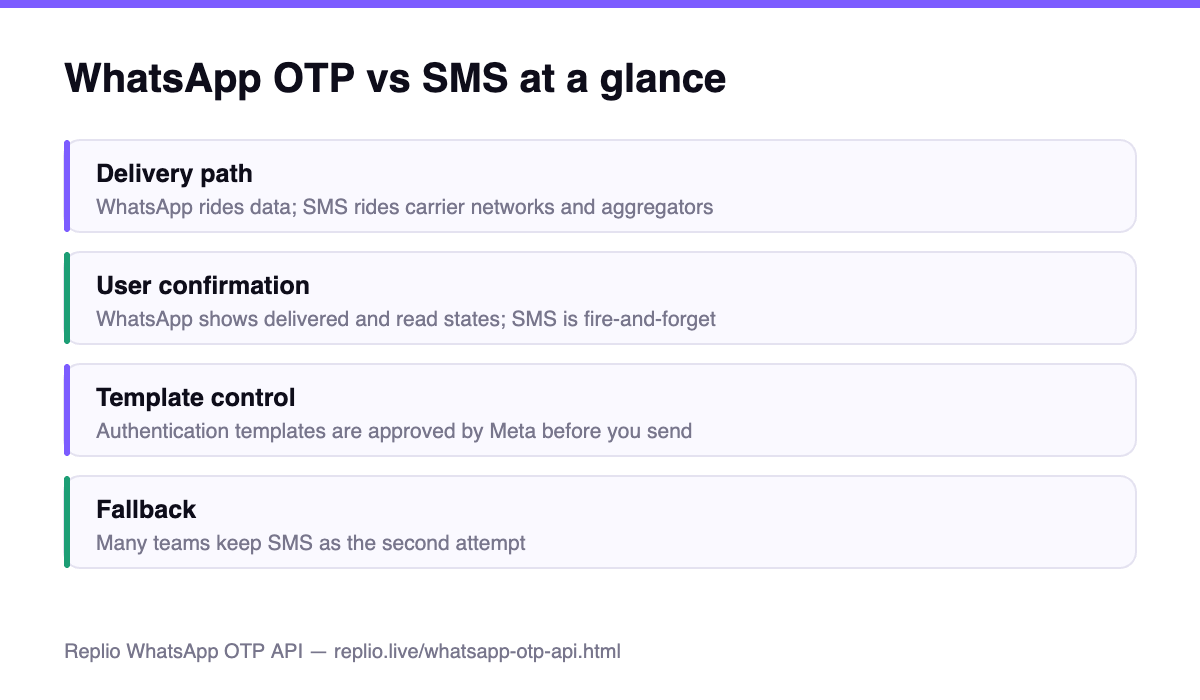
WhatsApp OTP vs SMS compared across delivery, confirmation, templates and fallback
The four differences that matter in production.

WhatsApp OTP vs SMS: two very different delivery paths

An SMS travels over carrier networks. It usually passes through an aggregator, then one or more carriers, before it reaches the handset. Each hop can filter, delay or silently drop it. You rarely find out which.

A WhatsApp message travels over the internet to Meta, then to the app on the device. There is no carrier in the middle. That removes a class of failure, and adds a different one: the recipient needs WhatsApp installed and online.

What SMS verification still does better

SMS reaches every phone. No app, no data plan, no account. For a service with older or low-connectivity users, that reach is hard to argue with.

SMS also needs no approval. You write the message and send it. WhatsApp does not work that way, which is the next section.

Where WhatsApp verification pulls ahead

Three things change in your favour.

  • You learn what happened. WhatsApp reports delivered and read states. SMS is largely fire-and-forget, so a failed signup gives you nothing to debug.
  • The code arrives from your business. Messages come from your verified number rather than a rotating shortcode, so the sender is recognisable.
  • One-tap entry. Meta’s authentication templates support a copy-code button, which removes the retyping step where users fat-finger a digit.

There is a second-order effect worth naming. Because WhatsApp reports read receipts, a stalled signup stops being a mystery. You can see whether the code was delivered, whether it was opened, and whether the user simply abandoned the form. That turns a support guess into a measurable step you can fix.

The template rule that catches teams out

WhatsApp requires business-initiated messages to use a template Meta has approved in advance. For verification you want an Authentication category template. Meta ships a library of them, so most teams pick one rather than write their own.

Marketing templates are not a substitute. Sending a verification code on a marketing template sidesteps opt-out rules and is a common route to getting a number restricted. Providers reject it outright. Replio, for example, returns a template_not_allowed error rather than sending, per its published API reference.

What a verification code costs on each channel

SMS pricing varies by country and by aggregator, and it moves. WhatsApp conversation pricing is set by Meta and also varies by market. Neither channel is universally cheaper, so check your own corridors rather than trusting a blanket claim.

One structural difference is worth knowing. A few destinations cost noticeably more to reach on WhatsApp. Replio charges two credits instead of one for Indonesia, the United Arab Emirates and Malaysia, and returns the exact charge on every send. If your users concentrate in those markets, model it before you switch.

Choosing a default, and keeping a fallback

Most teams that move to WhatsApp do not delete SMS. They reorder it. WhatsApp becomes the first attempt, SMS becomes the retry when the first attempt fails.

That pattern handles the one genuine weakness. If a user has no WhatsApp account, the send fails with a clear error and your existing SMS path picks it up. The user notices nothing.

Whichever you pick, the security basics do not change. Generate codes from a cryptographically secure source, expire them in minutes rather than hours, and cap wrong guesses. If you would rather not own that logic, some providers generate and check the code for you and store only a hash of it.

Before you migrate anything

Run both channels side by side for a week on real signups. Compare completion rate, not delivery rate. Delivery tells you the message left; completion tells you the user actually got in.

If you are already using WhatsApp elsewhere in your business, the operational overhead is smaller than it looks. We covered how small teams handle WhatsApp and Instagram enquiries without working nights, and how the same channels are being used for customer service in Qatar.

Frequently asked questions

Is WhatsApp OTP more reliable than SMS?

Neither wins everywhere. WhatsApp removes carrier filtering and tells you when a code was delivered and read. SMS reaches handsets with no app and no data. Reliability depends on your users, not on the channel in the abstract.

Do I need Meta approval to send WhatsApp verification codes?

You need an approved template, not app review. Pick an Authentication template from Meta’s template library in WhatsApp Manager. Approval is usually quick because the wording is Meta’s own.

What happens if the user has no WhatsApp?

The send fails and returns an error. Treat that as the trigger for your SMS fallback rather than as a dead end.

Can I keep my existing verification logic?

Yes. Most WhatsApp OTP APIs let you pass a code you generated yourself and simply deliver it. Only omit the code if you want the provider to generate and verify it for you.

Does WhatsApp OTP replace SMS entirely?

Rarely, and it does not need to. The common production pattern is WhatsApp first, SMS as the automatic retry.

Related Guides

China Just Fined AI Companion Apps for Getting Too Close to Users

China has started fining artificial-intelligence platforms under its first nationwide rule for AI companion apps. Penalties reach up to CNY 200,000 for violations tied to user harm. The China AI companion fines follow rules that took effect July 15. Five agencies issued those rules together, calling them the Interim Measures for the Administration of AI Anthropomorphic Interactive Services. Within days, two of China’s largest AI platforms shut down their customizable AI-persona features entirely.

What China’s new AI companion rule actually bans

The regulation targets services built around sustained emotional interaction. These services simulate human personality traits, thinking patterns and communication styles. The rule excludes customer-service bots, knowledge Q&A tools, workplace assistants, and education or research tools. Those tools qualify only if they avoid sustained emotional engagement with users.

Smartphone chatbot app screen, related to China AI companion fines

How the China AI companion fines are being enforced

The Cyberspace Administration of China oversees compliance and enforcement. Simple violations draw fines up to CNY 100,000. That figure rises to CNY 200,000 when a violation harms a citizen’s life, health or safety. Authorities can also order a service suspended for refusal to rectify, or in serious cases.

Why two of China’s biggest platforms shut down personas overnight

Two of China’s largest AI platforms shut down their customized AI-persona services within about ten days of receiving a cease-operation notice, according to reporting on the rollout. Both companies moved quickly once enforcement of the rule began on July 15.

What counts as emotional AI under the rule

Five agencies co-issued the Interim Measures on April 10, 2026. They are the Cyberspace Administration of China, the National Development and Reform Commission, the Ministry of Industry and Information Technology, the Ministry of Public Security, and the State Administration for Market Regulation. The defining line is “sustained emotional interaction.” That phrase covers services built around ongoing simulated relationships, not simple task completion.

How this compares with AI rules elsewhere

China’s approach to emotionally interactive AI stands apart from the European Union’s AI Act. That law focuses more broadly on risk classification and transparency for AI systems in general. It also requires that users learn when they’re interacting with AI at all. China’s rule instead singles out one specific category of service: sustained emotional simulation. It builds a dedicated framework around that category, backed by fines and the power to force a shutdown. Analysts tracking global AI regulation see the two approaches as complementary case studies. Both reflect how governments are choosing to regulate the same underlying technology. The underlying concern is shared across jurisdictions: emotionally realistic AI can shape vulnerable users’ behavior.

What happens as enforcement continues

The Cyberspace Administration has signaled ongoing monitoring, not a one-time compliance sweep. More fines are likely as enforcement continues. Regulators and analysts elsewhere are watching China’s framework closely. Many see it as one of the first national approaches of its kind to emotionally interactive AI.

What users of these apps can expect next

Users who relied on the shut-down persona features have had to switch to alternative apps. Others have accepted more limited functionality from their existing ones. Platforms that continue offering AI companion features in China now face a clear compliance bar. They must avoid sustained emotional simulation, or operate strictly under the new rule’s conditions. Some smaller developers may choose to exit the emotionally interactive AI category entirely. Building the compliance infrastructure the rule requires costs money that not every developer wants to spend. That calculation could reshape which companies stay active in this corner of China’s AI market over the coming months.

Why enforcement moved so quickly

Chinese regulators have shown a pattern this year of moving fast once a new AI rule takes effect. They tend not to allow a long grace period. The cease-operation notices issued to major platforms within days of the July 15 deadline reflect that same approach. Companies operating in China’s AI sector now treat compliance deadlines from Beijing as firm from day one. Few treat them as an opening position for negotiation. That approach contrasts with the phased rollout the EU has used for its own AI Act, where high-risk obligations only apply years after the law’s initial transparency requirements took hold.

China’s AI companion rules: common questions

What is the Interim Measures for the Administration of AI Anthropomorphic Interactive Services?

China’s first nationwide rule governing AI services designed for sustained emotional interaction with users. Five government agencies co-issued it.

When did the rule take effect?

July 15, 2026.

Who enforces the rule?

The Cyberspace Administration of China, working with four partner agencies that co-issued the regulation.

What are the penalties for violating it?

Fines up to CNY 100,000 for simple violations. That rises to CNY 200,000 when a violation harms a citizen’s life, health or safety, with possible service suspension in serious cases.

Are customer-service chatbots covered by the rule?

No, as long as they avoid sustained emotional engagement. The rule specifically excludes customer service, Q&A, workplace and education tools that meet that condition.

Could other countries adopt similar AI companion rules?

It’s too early to say. But analysts note China’s framework is one of the first of its kind, and regulators elsewhere are watching how it plays out.

Related coverage on Tamara News

Washington Is Quietly Rewriting the Rules for AI Chips — Here’s What’s Coming

The Commerce Department has confirmed new Commerce Department chip regulation is coming for artificial-intelligence hardware. Officials are staying deliberately vague on timing and targets. The signal follows a rule that already took effect January 15, 2026. That rule lets the Bureau of Industry and Security review license applications for advanced AI chips bound for China and Macau. Officials handle each application case by case. Exporters must first meet a set of supply, security and testing conditions. A further rule is expected. No formal date has been set.

What the Commerce Department has actually confirmed

A Commerce Department official confirmed that regulatory action targeting chips and artificial intelligence is coming. The confirmation stayed thin on specifics by design. Officials gave no formal rulemaking date. They also gave no defined target list.

Semiconductor wafer technology tied to Commerce Department chip regulation

How the current Commerce Department chip regulation already works

The Bureau of Industry and Security’s rule took effect January 15, 2026. It changed the export-license review policy for certain advanced computing semiconductors destined for China and Macau. Officials now evaluate license applications for specific AI chips case by case. Exporters must meet a series of supply, security and testing conditions first.

Why officials are staying vague on specifics

Commerce Department officials confirmed harsh new AI export rules are coming. At the same time, they explicitly denied reports that the administration plans to revive the Biden-era AI Diffusion Rule. That denial came from officials responding to reporting on the confirmation. Officials describe the coming approach as a new, separate framework for strategic AI accelerator export controls. They say it is not a return to the earlier rule.

Who this affects first

Chipmakers with significant AI accelerator sales bound for China face the most direct exposure. That includes firms like Nvidia and AMD, both exposed to any tightening of the current case-by-case review process. Cloud providers and enterprise buyers could also feel indirect effects. Many of them depend on those chips for AI infrastructure outside the US, so longer licensing timelines or stricter approval conditions would touch them too.

Why chip export policy keeps shifting

US policy on advanced AI chip exports has moved through several iterations in recent years. It reflects an ongoing balancing act. National-security concerns sit on one side. The commercial interests of American chipmakers sit on the other, since these firms rely heavily on international sales, including to China. Each round of rulemaking draws public comment from industry groups. They warn about losing market share to non-US competitors. National-security voices push back the other way, arguing for tighter controls. That tension will likely shape whatever the Commerce Department proposes next. Previous rounds of chip export policy have also triggered retaliatory measures and workaround strategies from affected buyers. That history makes each new rule as much a diplomatic and commercial calculation as a technical one.

What happens once a formal rule appears

Export-control rulemaking like this typically moves through a formal proposal and comment process before taking effect. Industry pushback tends to follow once specifics get published. No timeline has been set publicly for that next step. Still, the January 2026 rule offers a template for how any new case-by-case licensing framework might look.

What companies can do while they wait

Chipmakers and their customers cannot yet plan around specific new terms, since none have been published. Legal and trade-compliance teams typically use this waiting period to review how the current January 2026 licensing framework has applied to their own shipments. That groundwork often makes it easier to respond quickly once a formal proposal appears and a public comment window opens. Companies with large China-linked AI hardware businesses have historically been among the most active participants in these comment periods, given how directly the rules affect their revenue.

How markets have reacted to past chip-policy signals

Chip stocks have moved on export-policy headlines before, even without a finalized rule in hand. A confirmed signal from the Commerce Department, absent specifics, tends to produce a milder market reaction than an actual published rule. Traders generally wait for the formal proposal before repricing individual stocks, since the eventual details, not the advance warning, determine which companies gain or lose the most.

AI chip export rules: quick answers

What is the Bureau of Industry and Security?

It is the arm of the US Commerce Department responsible for administering export controls, including on advanced semiconductors.

Did the US bring back the AI Diffusion Rule?

No. Commerce Department officials denied that. They describe the coming approach as new and separate from the Biden-era rule.

Which chips are affected right now?

Advanced AI accelerators bound for China and Macau. Officials currently review them case by case under the rule that took effect January 15, 2026.

When will the new Commerce Department chip regulation take effect?

No date has been set publicly as of this report.

Does this affect Nvidia specifically?

Yes, indirectly. Nvidia sells substantial AI hardware bound for China, which puts it directly in the path of any further tightening.

Where can I read the current export rule in detail?

Legal analyses of the January 2026 rule break down the current case-by-case review conditions. Firms that track export-control policy publish these regularly.

Related coverage on Tamara News

5 AI Customer Service Tools Qatar Businesses Actually Use in 2026

Answering customers at 2am used to mean a night-shift agent or an unanswered message. AI customer service in Qatar has largely closed that gap. A growing list of platforms now handle WhatsApp, Instagram and website chats around the clock, in Arabic and English. Businesses no longer need extra night staff to cover it. This roundup compares five platforms. It starts with a WhatsApp-first tool for small GCC businesses. Then it moves to the enterprise platforms bigger regional operations already run.

1. Replio: AI customer service built for Qatar businesses

Replio targets small and mid-size businesses with a WhatsApp-first AI customer service agent. It runs a Doha-based support line alongside its global product. It connects WhatsApp, Instagram DMs, Facebook Messenger, Telegram and a website chat widget into one shared inbox. It answers in more than 50 languages and reads photos and voice notes, not just typed text.

Replio builds its knowledge base from a business’s own FAQs, prices and policies. Answers reflect that specific business rather than a generic script. Beyond answering questions, Replio can take payments, book appointments and capture leads directly inside the conversation. It aims to complete the task itself, rather than log a ticket for a human to finish later.

Replio skips the usual technical hurdles during setup. WhatsApp connects in three clicks through Facebook login, with no developer account, API tokens or token-expiry issues to manage. Replio says the whole process takes under a minute. It needs no code and no in-house IT team.

Pricing starts free forever for Telegram and the web widget, capped at 50 messages a month. A WhatsApp-only tier costs $70/month. The Starter tier covers all channels at $150/month, Pro costs $300/month and Business costs $450/month, with discounts for annual billing. Businesses can try a 14-day free trial with no card required at the official Replio site.

2. Zendesk AI Agents: enterprise-grade customer service in Qatar

Zendesk ranks among the largest customer-service platforms in the world. Its AI Agents target teams that already run a full support desk. They hold a cross-channel conversation: a customer can start in chat, move to email, and finish on a phone call without repeating themselves. The agents support more than 80 languages, including switching languages mid-conversation. Agent Builder, a no-code tool, lets a business define its own policies and workflows without a development team.

Zendesk’s base Suite plans run from around $55 to $115 per agent per month, billed annually. Copilot costs $50 per agent as an add-on, and Zendesk bills AI Agent resolutions separately at roughly $1.50–$2 each. It suits larger support operations already using Zendesk, not a business setting up chat for the first time.

3. Freshworks Freddy AI: customer service automation for Qatar teams

Freddy AI is Freshworks’ AI suite across Freshdesk and Freshchat. It splits into two parts: an AI Agent that handles conversations independently, and a Copilot that assists human agents. The Copilot suggests replies, summarizes tickets and adjusts tone. It covers web chat, email and messaging channels including WhatsApp, Facebook and Instagram Messenger, and SMS, depending on the plan.

Freshchat has a genuine free tier covering a chat widget, shared inbox and basic permissions. This suits a small team testing live chat before paying for AI. Freshworks bills the Freddy AI Agent itself by session, at roughly $49 per 100 sessions. Copilot costs $29 per agent per month separately, on Pro and Enterprise plans.

AI customer service in Qatar

4. Fin AI (formerly Intercom): customer service after the Salesforce deal

Fin, previously marketed as Intercom’s AI agent, reads a customer’s question and searches the business’s own content for an answer. It replies in a human-like way. Salesforce agreed in June 2026 to acquire the company for roughly $3.6 billion. Salesforce says Fin already resolves around 76% of incoming requests on its own across its customer base. Once the deal closes, Salesforce plans to fold Fin’s technology into its Agentforce platform.

Salesforce prices Fin per outcome rather than per seat. A resolution, procedure handoff or disqualification costs $0.99; a qualified lead costs $9.99, with a 50-outcome monthly minimum. Running Fin stand-alone with a platform like Salesforce or HubSpot carries a $49.50 monthly minimum. Running it inside Intercom itself requires at least one paid seat, costing $29 to $139 a month.

5. AnswerForMe: WhatsApp customer service built for Qatar

AnswerForMe markets a WhatsApp-focused AI chatbot specifically to Qatari and wider GCC businesses. Its solutions page targets the local market directly. It says its AI resolves around 70% of inquiries without human intervention, handling customer service, sales questions and lead capture. Setup takes about five minutes and needs no technical knowledge. AnswerForMe doesn’t publish full pricing on its site, though it offers a free tier. Interested businesses must request a quote for paid plans directly through AnswerForMe’s Qatar page.

AI customer service in Qatar: how to choose

The right pick depends mostly on team size and existing tools. A business already running Zendesk or Salesforce gets the most value from Zendesk AI Agents or Fin. Both plug into infrastructure that’s likely already in place. A small or mid-size business messaging customers mainly on WhatsApp and Instagram does better with a WhatsApp-first tool like Replio or AnswerForMe. Neither needs a developer or a support-ops team to set up. Freshworks Freddy AI sits in between, useful for a team that wants a proper ticketing system alongside AI without Zendesk-level cost. If a business’s essential apps in Qatar already include WhatsApp and Instagram, a WhatsApp-native option usually answers customers fastest. This also applies to a company newly setting up in Qatar, since it skips the need for a night shift entirely.

AI customer service in Qatar: frequently asked questions

What is the best AI customer service tool for a small business in Qatar?
A business messaging customers mainly on WhatsApp and Instagram, without an existing help desk, usually sets up faster with a WhatsApp-first tool like Replio or AnswerForMe than with an enterprise platform.

Do these AI tools support Arabic?
Yes. Replio answers in more than 50 languages including Arabic, Zendesk supports more than 80 languages, and Freddy AI and AnswerForMe both operate in Arabic-speaking markets including Qatar.

Can AI customer service tools take payments in Qatar?
Replio can take payments directly inside a conversation. Zendesk, Freddy AI and Fin generally handle support and lead-handling rather than in-chat payments, though they can route a customer to a payment link.

Is Intercom still called Intercom in 2026?
The company’s AI product now goes to market as Fin. Salesforce agreed in June 2026 to acquire it and plans to fold its technology into Salesforce’s Agentforce platform once the deal closes.

Do any of these tools require a developer to set up?
Replio and AnswerForMe both set up without a developer or IT team. Zendesk’s Agent Builder is no-code but assumes an existing Zendesk account and support workflow; Freddy AI setup depends on the Freshdesk/Freshchat plan in use.

Is there a free option?
Replio offers Telegram and web-widget access free forever up to 50 messages a month. Freshchat has a genuine free tier for web chat. AnswerForMe offers a free tier without published limits. Zendesk and Fin don’t offer a meaningful free tier for AI agents.

Related Guides

Social Media Addiction Lawsuits Against Meta and Google Multiply

Big technology platforms are facing a wave of litigation over claims that their products are designed to be addictive to young users. A landmark verdict in March, followed by a fresh trial that opened this month, has put the industry’s legal exposure in sharp focus: the social media addiction lawsuits now number in the thousands, with Meta and Google among the most exposed defendants.

How the social media addiction lawsuits reached this scale

social media addiction lawsuits

A Los Angeles jury found Meta Platforms and Google negligent in the design and operation of their platforms, awarding $6 million to a 20-year-old plaintiff in what plaintiffs’ attorneys called a landmark verdict. That case has opened the floodgates: thousands of additional lawsuits are now working through courts, with a new Meta trial examined in detail by Bloomberg, which reports the litigation could reshape how platforms design recommendation algorithms and engagement features for minors.

Plaintiffs argue the companies engineered features such as infinite scroll, autoplay and variable-reward notifications specifically to maximize time spent on the apps, with insufficient regard for the mental health impact on teenage users, according to reporting from Time.

Why state legislatures are moving too

The courtroom pressure is being matched by new state laws. Illinois enacted legislation in July barring platforms from using minors’ viewing histories or device data to curate feeds, restricting notifications between 10pm and 7am, and requiring stronger default privacy settings for younger users, though the law does not take effect until 2028. At least 40 states and Puerto Rico considered more than 300 measures related to children and social media during the 2026 legislative session, with roughly 10 adopting new laws or resolutions.

How platforms are responding

Meta and Google have both said their platforms already include parental controls and age-appropriate design features, and they are contesting the negligence findings on appeal. The industry has also been lobbying against some of the more restrictive state bills, arguing that broad content-curation limits could conflict with federal law and free-speech protections. The dynamic echoes tensions elsewhere in tech regulation, including how platforms are adapting customer-facing AI tools under scrutiny, a theme we’ve tracked in small businesses using WhatsApp and Instagram AI support tools.

What comes next for the platforms

More trials are scheduled through the rest of 2026, and a coordinated multidistrict litigation process is consolidating discovery across many of the individual cases, which could speed settlements or set precedents that shape future verdicts. Meanwhile, more states are expected to introduce youth social media legislation when new sessions begin in January, meaning the regulatory and legal pressure on platforms is unlikely to ease soon. Investors are also watching closely: repeated adverse verdicts could push platforms toward costly design changes or settlements that dent margins already under pressure from heavy AI infrastructure spending, a dynamic we examined in our coverage of AI infrastructure debt across the tech sector.

Regulators outside the US are watching too. The EU’s own push to police algorithmic transparency, which we covered in our report on the EU AI Act’s transparency rules, has already forced some platforms to disclose more about how their recommendation systems work, and plaintiffs’ lawyers in the US cases have signaled they may look to those disclosures as evidence in future filings.

Social media lawsuits: frequently asked questions

What triggered the wave of social media addiction lawsuits?
A March verdict found Meta and Google negligent in platform design, awarding $6 million to a plaintiff, which opened the door to thousands of additional suits.

What do plaintiffs allege?
They argue platforms used features like infinite scroll and variable-reward notifications to intentionally maximize engagement among minors, harming their mental health.

Which companies are named in the litigation?
Meta, Google, TikTok and Snap are among the companies facing lawsuits, according to reporting on the litigation.

What did Illinois’ new law do?
It restricts the use of minors’ data for feed curation, limits nighttime notifications, and strengthens default privacy settings, though it does not take effect until 2028.

How many states have considered similar legislation?
At least 40 states and Puerto Rico considered more than 300 related measures during the 2026 legislative session.

Are the companies appealing the verdicts?
Yes, Meta and Google are contesting negligence findings while pointing to existing parental control and safety features.