• Mon - Fri 9.00 - 19.00

Yearly Archives: 2026

A Himalayan River Swallowed Nine Bridges — And Hundreds of Lives

The Nepal flash floods disaster tore through the upper Trishuli River valley on the morning of August 26, 2026. Water swept through settlements in the Rasuwa and Nuwakot districts, then crossed into Tibet. Officials confirmed dozens of deaths on both sides of the border within a day. The number of missing people kept climbing as rescue teams struggled to reach the worst-hit villages.

By August 27, Nepali authorities had counted close to 100 confirmed deaths inside the country. Three more deaths were confirmed in neighboring Tibet. Several hundred more people were reported missing. The list includes foreign trekkers and mountain guides who were in the region for the peak of the secondary Himalayan trekking season. Aid workers say the toll will likely rise once crews clear flood debris and restore communications to cut-off hamlets.

What set off the Nepal flash floods disaster

Investigators suspect a glacial lake outburst or a landslide dam break on the Bhotekoshi tributary, which feeds into the Trishuli River. Heavy monsoon rain had already soaked the surrounding slopes for several days. When the natural dam gave way, a wall of water and debris raced down the narrow valley. It moved faster than local warning systems could react, catching villages, guesthouses and road crews off guard.
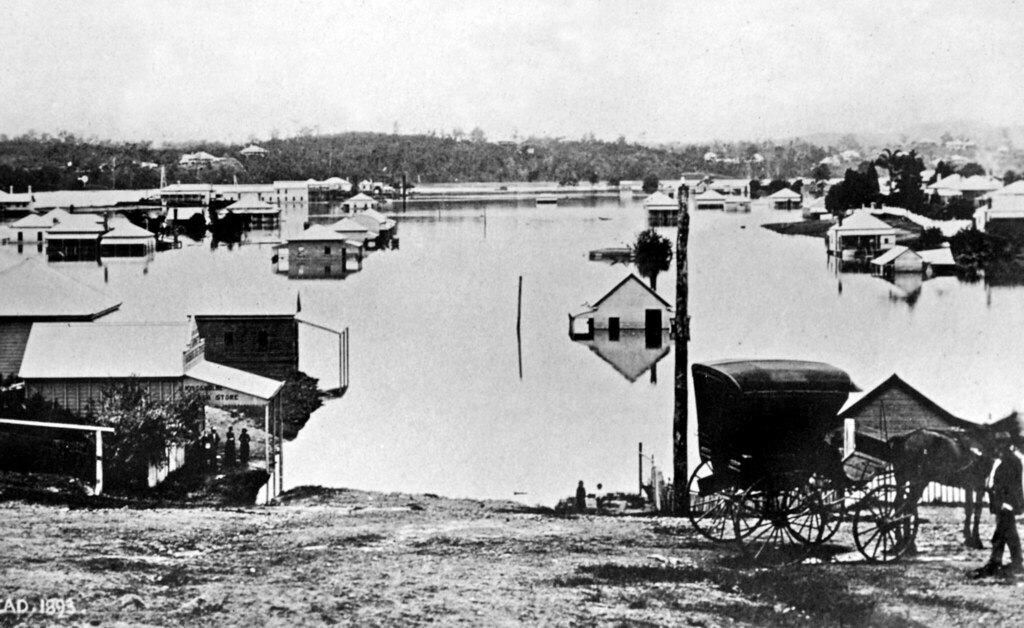
Rescue efforts after the Nepal flash floods disaster along a swollen river

Nepal sits in one of the most glacially active mountain ranges on Earth. Scientists who study the Himalayas have warned for years that retreating ice is creating more of these unstable glacial lakes. Nepal, Bhutan and northern India have all seen similar outburst floods more often over the past decade. Each event has its own trigger, and investigators are still confirming this one.

Confirmed deaths and a missing list that keeps growing

Nepal’s home ministry and disaster response agencies reported between 95 and 98 confirmed deaths inside the country in the first 24 hours. The Nepal Tourism Board separately released a preliminary missing-persons count of 384 people. That figure includes 291 foreign nationals and 93 Nepali citizens. Officials called the count provisional, since many communication lines in the valley remain down.

Search teams have recovered bodies several kilometers downstream from where victims were likely swept in, which complicates identification. Officials have asked families abroad to register missing relatives through their embassies rather than travel to Nepal directly. Road access into the disaster zone still relies mostly on helicopters and foot travel.

Foreign trekkers caught in the surge

August sits inside Nepal’s quieter but still active trekking window. The flooded valleys line routes travelers use toward the Rasuwagadhi border crossing with China. Consular officials from several countries, including the United States, said they were working to confirm the whereabouts of citizens known to be traveling through the area. Families of missing trekkers have turned to social media to share photos and last-known locations while they wait for official updates.

Bridges, roads and a trade route washed away

Nepal’s disaster management authority says the floodwaters destroyed nine bridges and nearly 40 kilometers of road. That destruction severed the main overland route between Kathmandu and the Rasuwagadhi border post. On the other side, the Gyirong Port crossing, a key channel for Nepal-China trade, has also taken damage. Supply lines that both countries rely on are now disrupted.

What happens next for search and rescue

Nepal’s army and armed police have sent helicopters to reach communities cut off by the collapsed roads. Chinese rescue teams are working the Tibetan side of the border. Aid groups, including UNICEF, say their immediate priority is reaching children and families stranded without supplies. Nepali officials have not given a timeline for reopening the Kathmandu-Rasuwagadhi highway or the border crossing. Rebuilding the destroyed bridges is expected to take months, not weeks.

Frequently asked questions about the Nepal flash floods disaster

What caused the flooding? Officials suspect a glacial lake outburst or a landslide dam break on a Trishuli River tributary, worsened by days of monsoon rain.

How many people have died? Nearly 100 confirmed deaths in Nepal and three in Tibet as of August 27, with officials warning the toll will likely rise.

How many people are missing? Nepal’s Tourism Board listed 384 people as missing in an initial count, including 291 foreign nationals.

Were foreign tourists affected? Yes. The flooded valley sits along a popular trekking corridor, and consular officials are working to confirm the status of foreign nationals.

Is the Nepal-China border crossing open? No. The Rasuwagadhi crossing and the Gyirong Port trade route are both disrupted after bridges and roads were destroyed.

Where can families get updates on someone missing? Nepal’s Tourism Board and home ministry are coordinating identification efforts; embassies remain the fastest point of contact for foreign nationals.

For related coverage of this month’s other emergencies, see our reporting on the deadly ambush on UN peacekeepers in South Sudan and the measles outbreak in Pennsylvania.

Sources: NPR, Al Jazeera.
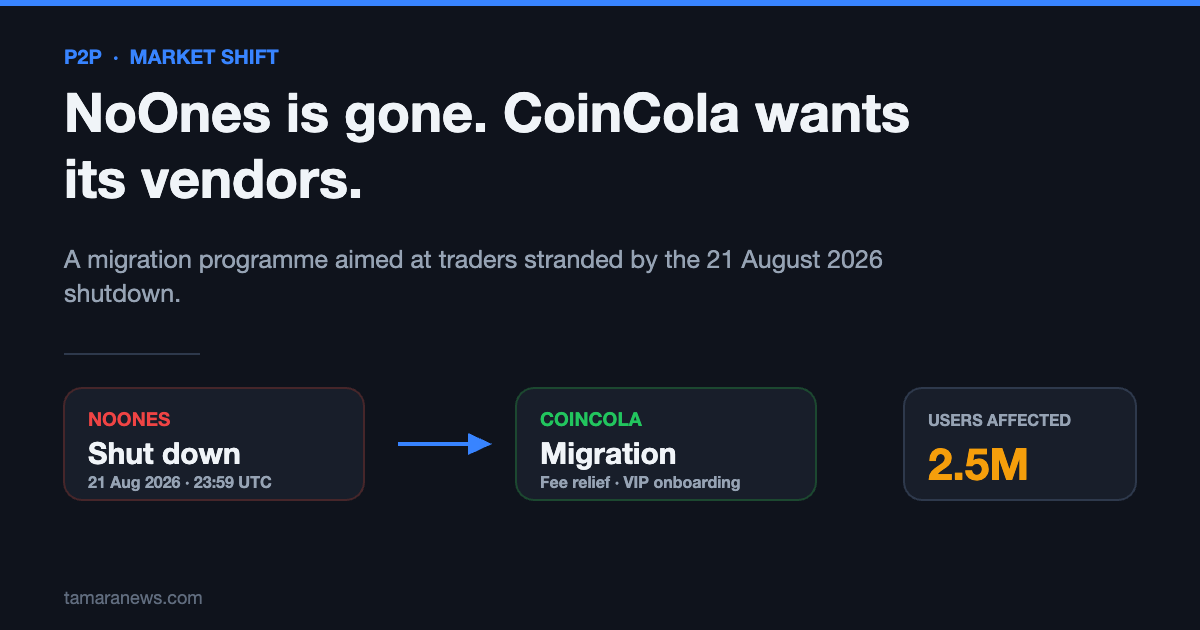
NoOnes Took 2.5 Million Traders Offline. CoinCola Wants Them Back

When NoOnes switched off its peer-to-peer marketplace on 21 August 2026, it did not just close a website. It stranded vendors who had spent years building reputation scores that existed nowhere else. The CoinCola migration program, announced this week, is an attempt to catch some of them before they drift to WhatsApp groups and Telegram channels where nobody holds the escrow.

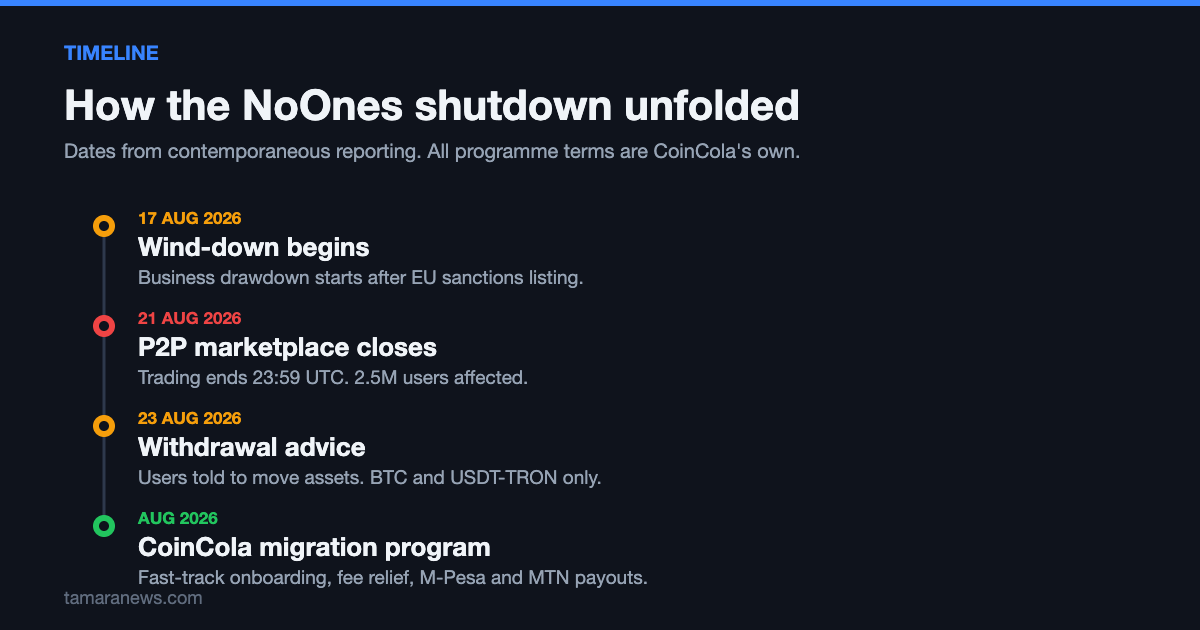
NoOnes had passed 2.5 million users earlier in 2026. The wind-down began on 17 August. The P2P marketplace closed at 23:59 UTC on 21 August, and the platform told users to pull their assets by 23 August. Withdrawals now run only over the Bitcoin network and Tether on TRON.

The cause was not a hack or a bank run. The EU added NoOnes to its Russia-related sanctions list. Partners cut ties, blockchain monitoring firms flagged the platform as high risk, and normal operations became impossible. We covered that collapse and what it meant for user funds in our earlier report on the NoOnes shutdown.

Timeline of the NoOnes shutdown leading to the CoinCola migration program, from 17 to 23 August 2026
The NoOnes wind-down ran over six days in August 2026.

What the CoinCola migration program actually offers

CoinCola describes the package as a transition pathway for three groups: P2P vendors, gift card traders, and ordinary users who held balances. According to the company, it covers five areas.

  • Fast-track vendor migration. Former NoOnes vendors can submit verifiable trading history. CoinCola says it will recognise eligible vendor reputation status and cut P2P fees for those who qualify.
  • VIP onboarding. The company promises a dedicated account team, 24/7 priority dispute handling, and guidance on moving assets across.
  • Mobile money payouts in Kenya and Ghana. CoinCola cites direct withdrawal integration with M-Pesa in Kenya, and MTN Mobile Money and Vodafone Cash in Ghana, with no extra deposit requirement.
  • Gift card escrow. Multi-layer escrow, anti-fraud screening, and dedicated dispute handling on eligible gift card trades.
  • Transition incentives. Fee discount vouchers and signup rewards aimed at traders working in Kenyan shillings and Ghanaian cedis.

Every one of those points comes from CoinCola. None has been independently verified, and the company has not published the eligibility thresholds, the size of the fee reduction, or how it will validate a trading history from a platform that no longer serves data.

Why reputation, not money, is the real loss

A P2P vendor’s balance is portable. Their reputation is not. Trade counts, completion rates, and dispute records sit inside one platform’s database. When that platform closes, a vendor with four years of history restarts at zero somewhere else.

That matters because reputation sets pricing power. Established vendors quote tighter spreads and attract larger orders precisely because buyers trust the badge. Strip it away and the vendor competes on price alone against strangers.

CoinCola says it identified three pressures on affected traders: keeping cash flow moving, preserving that track record, and avoiding unverified trades arranged over social channels. The third is the dangerous one. When a marketplace disappears, deals migrate to group chats, and group chats have no escrow.

“When a major marketplace halts trading, vendors risk losing both their working capital and the trading history they built over years,” said January, Content Manager at CoinCola.

The gift card corridor few outsiders track

Gift cards function as a remittance rail in several markets. A relative abroad buys a retail or digital card. The recipient sells it on a P2P marketplace and receives local currency. The money covers school fees, rent, or stock for a small business.

This corridor rarely appears in remittance statistics, because a gift card is not a wire transfer. It still moves real household income. NoOnes carried a meaningful share of that flow, which is why its closure reached further than its user count suggests.

What traders should check before migrating

An offer of continuity is appealing when your income has just stopped. It still deserves the same scrutiny you would apply to any platform holding your funds.

  • Get the fee terms in writing. “Reduced P2P fees” is not a number. Ask what the rate becomes, and how long the reduction lasts.
  • Test a small withdrawal first. Move a minor amount out before you move a large one. Confirm it lands, and note how long it takes.
  • Check the licensing position. CoinCola does not hold a licence from a major financial regulator. Weigh that against platforms that do.
  • Read the reviews yourself. CoinCola’s public review pages include complaints about frozen accounts and delayed withdrawals. Read them before you commit working capital.
  • Keep your own records. Export whatever NoOnes history you still have. It is the only proof of your track record that you control.

Traders comparing options may also want to look at how signup incentives stack up, including CoinCola’s first naira trade bonus, before choosing where to rebuild.

What happens next

NoOnes has not said when withdrawal-only access ends. Anyone still holding a balance should move it now rather than wait for a deadline that may never be announced.

For CoinCola, the opportunity is obvious. A rival with millions of users has exited, and the vendors who supplied that liquidity are looking for somewhere to trade. Whether the promises in this programme survive contact with real volume is the part worth watching, and the part no press release can settle.

Eligible traders can review the terms on CoinCola’s NoOnes transition page. Reporting on the sanctions that forced the closure is available via CryptoSlate and BeInCrypto.

Frequently asked questions

When exactly did NoOnes shut down?

The wind-down started on 17 August 2026. The P2P marketplace closed at 23:59 UTC on 21 August 2026. NoOnes advised users to withdraw assets by 23 August 2026.

Why did NoOnes close?

The EU added the platform to its Russia-related sanctions list. Partners withdrew, monitoring firms classified it as high risk, and continued operation became unworkable.

Can I still withdraw funds from NoOnes?

Withdrawals run only over the Bitcoin network and Tether on TRON. NoOnes has not announced when that access ends, so move balances promptly.

Who qualifies for the CoinCola migration program?

CoinCola says former NoOnes vendors, gift card traders and P2P users qualify. Applicants with verified records of prior NoOnes volume go to a VIP queue. The company has not published exact thresholds.

Is CoinCola regulated?

CoinCola launched in 2017 and operates across Asia, Africa and Latin America. It does not hold a licence from a major financial regulator such as the SEC or FCA. Factor that into any decision.

Which mobile money services does the programme cover?

CoinCola lists M-Pesa in Kenya, plus MTN Mobile Money and Vodafone Cash in Ghana, with direct withdrawal and no additional deposit requirement.

Related Guides

The Chevening Window Opens in August — Be Ready, Not Rushed

Chevening is not won in October. It is won now. The Chevening Scholarship 2027 application opens in early August and closes on 6 October 2026, and the strongest candidates are already drafting essays and lining up referees. This fully funded route to a one-year UK master’s rewards preparation, not last-minute panic.

By the Tamara News editorial desk. Last updated 24 July 2026.

On this page

What Chevening actually funds

Chevening is the UK government’s flagship scholarship, and it is generous. It covers full tuition for an eligible one-year master’s, a monthly living stipend, economy flights to and from the United Kingdom, and a set of arrival and departure allowances. In return it looks for future leaders. The programme values what it calls “leadership and networking” potential, so your professional trajectory matters as much as your grades. You also commit to returning home for at least two years after the course, a condition that shapes how you should frame your career plan.

The timeline that decides your odds

Mark three dates. Applications open in early August 2026. The portal closes on 6 October 2026 at 11:00 UTC. And if you are shortlisted, you must hold at least one unconditional UK university offer by 8 July 2027. Ada, a Nigerian doctor planning a master’s in public health, treats August as writing month and September as review month, leaving October free for a calm final check. That rhythm beats the scramble most applicants fall into. The deadline does not move. Neither should your prep.

Want a second pair of eyes on your study-abroad plan? Start at https://wa.link/i9l1ec

Where strong applications are built

Four essays carry the application: leadership, networking, your study choice, and your career plan. Each needs a concrete story, not a list of adjectives. Pick three UK courses that clearly connect to your goals, and explain why the United Kingdom specifically. Line up two referees early and brief them on what each essay claims, so their words reinforce yours. Keep evidence of your work experience handy, because the eligibility check is strict. Weak applications read like a CV. Strong ones read like a plan.

Before you hit submit

  • Applications open August, close 6 October 2026.
  • Four essays: leadership, networking, study, career.
  • Around two years of work experience is expected.
  • You return home for two years after the course.

Common questions

When does the Chevening 2027 application open and close?
It opens in early August 2026 and closes on 6 October 2026 at 11:00 UTC, with no extensions.

How much work experience do I need?
Most applicants need about two years, roughly 2,800 hours, though the exact rule depends on your country.

What does the scholarship cover?
Tuition for a one-year UK master’s, a monthly living stipend, and return flights.

Do I need a UK offer before applying?
No. You apply first, then must hold an unconditional UK offer by 8 July 2027.

Related reads

Share this story

  • LinkedIn: The Chevening 2027 window opens in August. Preparation beats panic every time.
  • Twitter: Chevening 2027 closes 6 Oct 2026. Fully funded UK master’s. Start now.
  • Facebook: Dreaming of a UK master’s? Chevening 2027 applications open in August.

Turn a UK degree into your next chapter

A funded master’s can reset a career, but only if the application is ready before the rush. Build your essays, choose your courses, and brief your referees this month. Get organised with our study-abroad tools here: https://wa.link/i9l1ec

Sources


Tapay copy tradingGrow your money while you plan your moveTapay auto-copies a live trading strategy to your own account — spot & futures. Start free on demo, go live when you’re ready.Start free →

5 Refusal Reasons That Sink Skilled Visa Applications

A refusal letter rarely tells you much. It cites a rule, notes that the requirement was not met, and leaves you to work out which document failed and why. The frustrating part is how repetitive the underlying causes are. Across the major destinations, the same skilled work visa refusal reasons account for the large majority of negative decisions, and nearly all of them are fixable before you press submit rather than after.

By the Tamara News editorial desk. Last updated 21 July 2026. Reviewed annually.

The five failure points at a glance

Failure pointWhere it bites hardestThe fix
Funds not held long enoughCanada, Australia, UKSeason the account for the full required period
Credentials not formally assessedCanada, GermanyComplete recognition before filing, not after
Salary below the current thresholdUK, Australia, NetherlandsCheck the threshold in force on your filing date
Work history that cannot be evidencedAll destinationsReference letters with duties, hours and dates
Undisclosed prior refusalAll destinationsDeclare everything, including withdrawn applications

Where the money tests actually fail

Settlement funds are the most common single cause. The mistake is almost never the amount. It is the holding period. Canada requires proof that funds have been available, not merely present on one day, and both UK and Australian caseworkers look for a consistent balance across the qualifying window. A lump sum that appears three days before you file reads as borrowed money, because usually it is.

Fix it by seasoning the account for the full period the destination specifies, and by being ready to explain any large deposit with a documented source. Gift letters, sale contracts and loan agreements are acceptable when they are dated and consistent.

Credentials and salary thresholds

Educational credential assessment catches people who assume their degree speaks for itself. Canada wants an approved assessment body report. Germany wants formal recognition of regulated professions before a permit issues. Starting either process after filing means months of delay at best.

Salary thresholds move, often annually and sometimes mid-year. Australia lifted its skilled migration income thresholds again on 1 July 2026. The UK has been adjusting its going rates alongside wider rule changes. The number that matters is the one in force on the day your application is lodged, not the figure you researched last winter. Confirm it the week you file.

Rather have someone audit the file before it goes anywhere near a caseworker? Start here: https://wa.link/i9l1ec

Work history and disclosure

Reference letters sink more applications than weak CVs do. A letter that confirms employment dates but omits duties, weekly hours and salary cannot support a points claim or an occupation match. Ask former employers for specifics, on letterhead, signed and dated.

Disclosure is the unforgiving one. A Pakistani IT specialist applying to Canada had a Schengen visitor visa refused in 2019, forgot it, and answered no to the prior refusal question. The refusal itself would not have blocked him. The inaccurate answer triggered a misrepresentation finding and a five-year bar. Declare every refusal, withdrawal and overstay, however old or minor it seems. Explaining a refusal is straightforward. Explaining an omission is not.

Frequent questions

Can I reapply immediately after a refusal?
Usually yes, provided no ban was imposed. Fix the underlying defect first, because an identical resubmission tends to produce an identical outcome.

Does a refusal from one country affect another?
It must be declared, and it may prompt extra scrutiny, but a properly explained refusal is not normally fatal elsewhere.

How long should funds be held?
It varies by destination, commonly between three and six months. Check the specific rule for your route rather than assuming a general standard.

Is an appeal better than reapplying?
Appeal where the decision misapplied the law. Reapply where the file was simply incomplete. The second is faster and far more often the right call.

Related reads

Share this story

  • LinkedIn: Five errors explain most skilled visa refusals. All five are fixable before you file.
  • Twitter: Undeclared refusals cause more damage than the original refusals ever did.
  • Facebook: Before you submit a skilled work visa application, check it against these five failure points.

Fix the file before a caseworker does it for you

Every item above is cheap to correct now and expensive to correct after a refusal. Seasoned funds, assessed credentials, a threshold confirmed in the week you file, reference letters with real detail, and a complete disclosure history. Get those five right and you remove most of the risk you can actually control. If you want a second reader on it, or you want to test which route fits you using our visa eligibility checker first, we are here: https://wa.link/i9l1ec

Sources


Tapay copy tradingGrow your money while you plan your moveTapay auto-copies a live trading strategy to your own account — spot & futures. Start free on demo, go live when you’re ready.Start free →

Your Verification Codes Arrive. That Doesn’t Mean They’re Read.

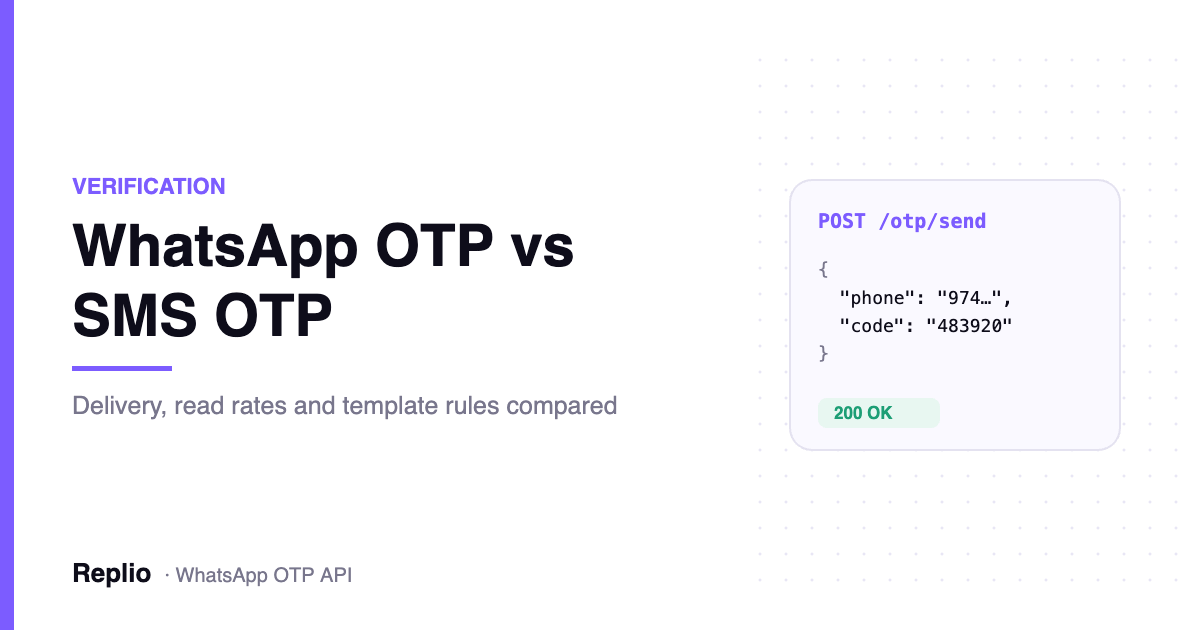
Signup codes fail quietly. The message leaves your server, the gateway reports success, and the user still never types anything in. WhatsApp OTP vs SMS is the choice most teams make once, early, and never revisit. It is worth revisiting, because the two channels behave very differently once a code leaves your application.

This guide compares them on the things that decide whether a signup completes: how each one reaches the handset, what you learn afterwards, what the rules allow you to send, and what a single code costs.

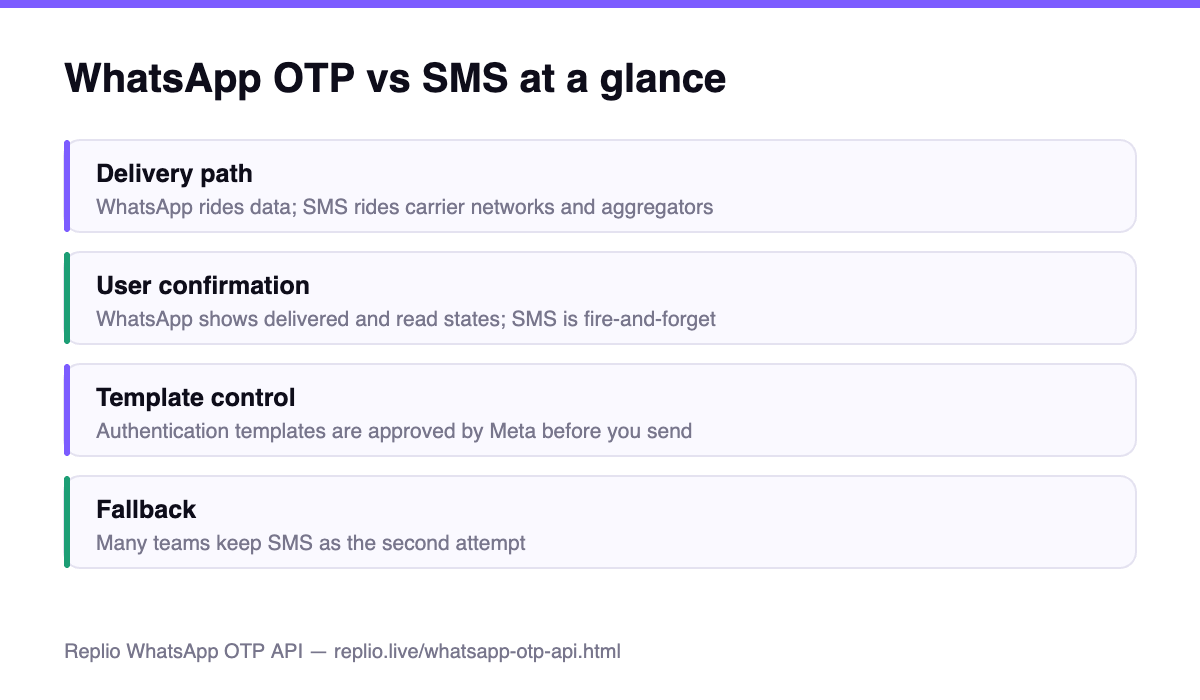
WhatsApp OTP vs SMS compared across delivery, confirmation, templates and fallback
The four differences that matter in production.

WhatsApp OTP vs SMS: two very different delivery paths

An SMS travels over carrier networks. It usually passes through an aggregator, then one or more carriers, before it reaches the handset. Each hop can filter, delay or silently drop it. You rarely find out which.

A WhatsApp message travels over the internet to Meta, then to the app on the device. There is no carrier in the middle. That removes a class of failure, and adds a different one: the recipient needs WhatsApp installed and online.

What SMS verification still does better

SMS reaches every phone. No app, no data plan, no account. For a service with older or low-connectivity users, that reach is hard to argue with.

SMS also needs no approval. You write the message and send it. WhatsApp does not work that way, which is the next section.

Where WhatsApp verification pulls ahead

Three things change in your favour.

  • You learn what happened. WhatsApp reports delivered and read states. SMS is largely fire-and-forget, so a failed signup gives you nothing to debug.
  • The code arrives from your business. Messages come from your verified number rather than a rotating shortcode, so the sender is recognisable.
  • One-tap entry. Meta’s authentication templates support a copy-code button, which removes the retyping step where users fat-finger a digit.

There is a second-order effect worth naming. Because WhatsApp reports read receipts, a stalled signup stops being a mystery. You can see whether the code was delivered, whether it was opened, and whether the user simply abandoned the form. That turns a support guess into a measurable step you can fix.

The template rule that catches teams out

WhatsApp requires business-initiated messages to use a template Meta has approved in advance. For verification you want an Authentication category template. Meta ships a library of them, so most teams pick one rather than write their own.

Marketing templates are not a substitute. Sending a verification code on a marketing template sidesteps opt-out rules and is a common route to getting a number restricted. Providers reject it outright. Replio, for example, returns a template_not_allowed error rather than sending, per its published API reference.

What a verification code costs on each channel

SMS pricing varies by country and by aggregator, and it moves. WhatsApp conversation pricing is set by Meta and also varies by market. Neither channel is universally cheaper, so check your own corridors rather than trusting a blanket claim.

One structural difference is worth knowing. A few destinations cost noticeably more to reach on WhatsApp. Replio charges two credits instead of one for Indonesia, the United Arab Emirates and Malaysia, and returns the exact charge on every send. If your users concentrate in those markets, model it before you switch.

Choosing a default, and keeping a fallback

Most teams that move to WhatsApp do not delete SMS. They reorder it. WhatsApp becomes the first attempt, SMS becomes the retry when the first attempt fails.

That pattern handles the one genuine weakness. If a user has no WhatsApp account, the send fails with a clear error and your existing SMS path picks it up. The user notices nothing.

Whichever you pick, the security basics do not change. Generate codes from a cryptographically secure source, expire them in minutes rather than hours, and cap wrong guesses. If you would rather not own that logic, some providers generate and check the code for you and store only a hash of it.

Before you migrate anything

Run both channels side by side for a week on real signups. Compare completion rate, not delivery rate. Delivery tells you the message left; completion tells you the user actually got in.

If you are already using WhatsApp elsewhere in your business, the operational overhead is smaller than it looks. We covered how small teams handle WhatsApp and Instagram enquiries without working nights, and how the same channels are being used for customer service in Qatar.

Frequently asked questions

Is WhatsApp OTP more reliable than SMS?

Neither wins everywhere. WhatsApp removes carrier filtering and tells you when a code was delivered and read. SMS reaches handsets with no app and no data. Reliability depends on your users, not on the channel in the abstract.

Do I need Meta approval to send WhatsApp verification codes?

You need an approved template, not app review. Pick an Authentication template from Meta’s template library in WhatsApp Manager. Approval is usually quick because the wording is Meta’s own.

What happens if the user has no WhatsApp?

The send fails and returns an error. Treat that as the trigger for your SMS fallback rather than as a dead end.

Can I keep my existing verification logic?

Yes. Most WhatsApp OTP APIs let you pass a code you generated yourself and simply deliver it. Only omit the code if you want the provider to generate and verify it for you.

Does WhatsApp OTP replace SMS entirely?

Rarely, and it does not need to. The common production pattern is WhatsApp first, SMS as the automatic retry.

Related Guides