
Category Archives: Work Permits

A Federal Judge Just Tore Up the $100,000 H-1B Fee. Here’s Why It Won’t Be the Last Word

The H-1B fee struck down this week by a federal judge in California leaves the Trump administration’s $100,000 charge on new H-1B petitions blocked for now, but employers hoping the issue is settled should hold off celebrating — a proposed replacement fee of $103,265 remains under review at the Department of Homeland Security. US District Judge Haywood S. Gilliam Jr., ruling in the Northern District of California on September 30, found the fee policy “arbitrary and capricious” and vacated it entirely, saying the administration failed to consider alternatives or the reliance interests of employers and workers affected by the sudden charge.

It is the second time a federal court has struck down the fee. A Massachusetts judge issued a similar nationwide ruling back in June 2026, finding comparable procedural defects in how the policy was imposed.

Why the H-1B fee struck down ruling matters

Judge Gilliam’s ruling centers on process rather than the underlying policy goal. The court found that imposing a $100,000 fee on H-1B petitions amounted to a “legislative rule” — a substantive change requiring the formal notice-and-comment process under the Administrative Procedure Act — rather than something the administration could simply impose by fiat. “There is no question here that Agency Defendants failed to consider any alternatives or the reliance interests of the regulated parties,” Gilliam wrote in his order, according to court filings reviewed by legal reporters.

The practical effect is that enforcement of the $100,000 fee is enjoined until the administration completes proper notice-and-comment rulemaking — a process that typically takes months and allows the public, employers, and advocacy groups to formally weigh in before a rule takes effect.
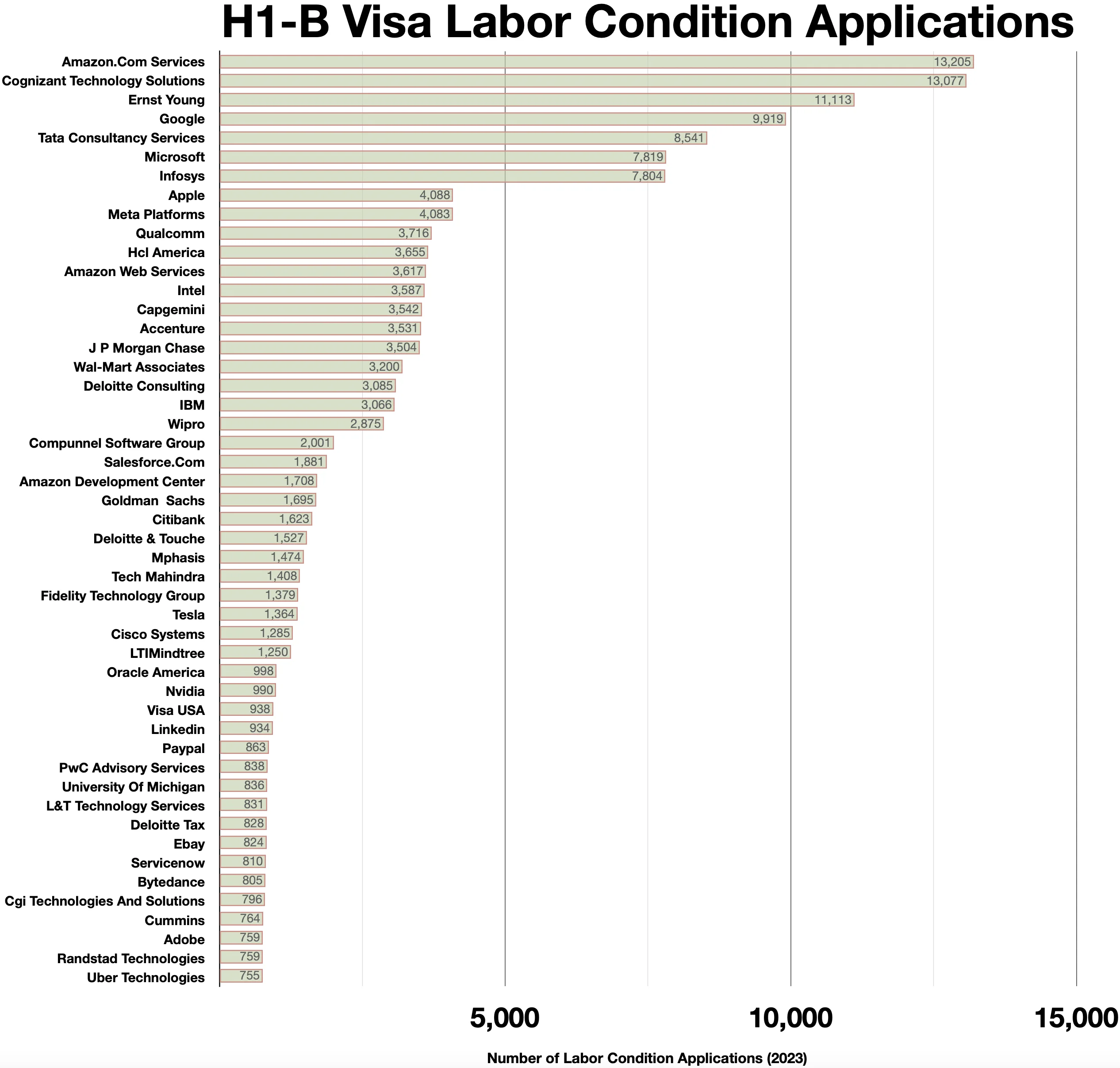
H-1B fee struck down: chart of H-1B visa applications by employer

What comes after the H-1B fee struck down decision

The ruling does not mean H-1B fees are off the table permanently. The Department of Homeland Security has a separate, proposed $103,265 fee already under review, and nothing in Gilliam’s decision prevents the administration from pursuing that or a similar charge through the proper rulemaking channel. Given that two separate federal courts have now struck down versions of this policy on nearly identical procedural grounds, any future attempt would likely need to clear the notice-and-comment bar explicitly to survive a legal challenge.

Immigration attorney Charles Kuck, among those who have tracked the litigation closely, has noted that the administration’s repeated attempts to impose steep H-1B fees without formal rulemaking suggest an urgency to raise the cost of the program quickly — an urgency that keeps running into the same procedural wall in court.

What this means for employers and visa holders

For now, employers filing new H-1B petitions are not subject to the $100,000 fee, restoring the prior cost structure while the legal situation remains unsettled. Companies that paid the fee before it was struck down, or that held back petitions due to the cost, will be watching closely for guidance from USCIS on how the agency plans to implement the court’s order in practice. The uncertainty itself has been costly for employers trying to plan hiring around a program whose cost structure has shifted multiple times within a single year.

What to watch next

The key date to watch is whether and when DHS formally opens notice-and-comment rulemaking on the proposed $103,265 fee, which would start a public comment period typically lasting 30 to 60 days before any new rule could take effect. Continued litigation is also likely regardless of that process, given the stakes for both the administration’s immigration agenda and the tech and consulting firms that rely heavily on the H-1B program.

What readers are asking

Is the $100,000 H-1B fee still in effect?
No. The fee is currently blocked following Judge Gilliam’s September 30, 2026 ruling, which found the policy unlawful.

Why did the judge strike down the fee?
The court found the fee amounted to a substantive “legislative rule” that required formal notice-and-comment rulemaking, which the administration did not conduct before imposing it.

Is this the first court to block the fee?
No. A Massachusetts federal judge issued a similar nationwide ruling against the fee in June 2026.

Could a new H-1B fee be introduced?
Yes. A proposed $103,265 fee announced by DHS in August 2026 remains under review and could move forward if the administration completes proper rulemaking.

What does “arbitrary and capricious” mean in this context?
It is a legal standard under the Administrative Procedure Act meaning the agency failed to reasonably justify its decision, including by not considering alternatives or the interests of affected parties.

Who is affected by this ruling?
Employers filing new H-1B petitions and the foreign workers those petitions cover are directly affected, as the ruling removes the $100,000 charge for now.

More on US visa policy

For more on US visa fee changes, see our coverage of the USCIS fee increases for asylum, parole, and TPS applicants and the new $750 expedited visa interview fee pilot. We also previously reported on the public charge rule change affecting green card applicants.

Sources

Canada Will Now Tell You Exactly How Long Your Work Permit Wait Is

If you are waiting on a Canadian work permit extension, there is good news. You can now see roughly how much longer that wait will last. Canada work permit processing estimates became personalized in late September 2026. Immigration, Refugees and Citizenship Canada quietly updated its processing times webpage. Instead of a single generic estimate for everyone, applicants now see a wait time tailored to their own submission date.

How the new Canada work permit processing tool works

The update lives on the same processing times page IRCC has run for years, but the mechanics changed. Applicants select “Temporary residence” as their application type. Then they choose “Work permit extension in Canada” from a dropdown menu. From there, the tool shows three things. It shows the estimated remaining wait in weeks, personalized to the applicant’s own submission date. It shows how many applicants are ahead of them in the queue. It shows the total number of people currently awaiting a decision.

People who have not yet applied can still use the tool. It will show them what their wait would look like if they submitted today. As of September 26, 2026, the page listed 202,900 applicants awaiting decisions in this category. That gives a sense of just how large the queue actually is.

Who the new estimates cover

The personalized estimates apply to three groups. In-Canada work permit holders extending an existing permit qualify. International student graduates submitting their first Post-Graduation Work Permit application qualify too. So do work permit holders who are changing the conditions attached to their existing permit.

A desk with forms reflecting Canada work permit processing updates

One group is notably excluded. First-time work permit applicants applying from outside Canada do not get a personalized estimate. They still use the original “Work permit in Canada” option, which shows standard, non-personalized processing time estimates. IRCC has not explained why that group was left out of this round of updates. It may simply reflect which application streams were technically easiest to convert first.

Why this matters for applicants

A generic processing time estimate tells an applicant almost nothing useful. It averages everyone together, regardless of when they applied or how the queue has moved since. A personalized estimate is different. It tells someone whether their application is near the front of the line, or still has months to go. That is based on real queue position, not a rough average.

That distinction matters most for people making real decisions around their status. Someone whose work authorization is about to expire needs a clear answer. Is a renewal decision weeks away, or months away? An average figure that might not apply to their case is not good enough. Employers sponsoring workers face the same planning problem, and a more accurate estimate helps them plan staffing with more confidence.

Part of a wider shift at IRCC

This is not IRCC’s first move toward personalized processing estimates. The department first launched personalized processing times for citizenship and permanent residence applications back in October 2025. Extending the same approach to work permit extensions and PGWP applications a year later suggests IRCC sees real value in the tool. It may plan to expand it further to other categories over time.

The timing also lands amid broader scrutiny of Canada’s immigration processing capacity. Previous reporting this year has tracked both increases and decreases in wait times across different application streams. IRCC keeps adjusting staffing and policy in response to application volume. A personalized tool does not by itself reduce the underlying backlog. But it gives applicants a clearer, more honest picture of where they actually stand.

What IRCC watchers should track

Watch for whether IRCC extends personalized estimates to first-time applications from outside Canada. That remains the one major gap in the current rollout. Also watch the overall queue size. The 202,900 figure recorded in late September is worth tracking in the months ahead. It offers a running signal of whether Canada’s work permit backlog is growing or shrinking under current policy.

Frequently asked

What changed with Canada work permit processing estimates?
IRCC updated its processing times webpage in late September 2026. It now shows personalized wait estimates based on an applicant’s own submission date, instead of one generic figure for everyone.

How do I see my personalized estimate?
Select “Temporary residence” as the application type on IRCC’s processing times page. Then choose “Work permit extension in Canada” from the dropdown.

Who qualifies for a personalized estimate?
Three groups qualify: in-Canada work permit holders extending their permit, international student graduates applying for their first PGWP, and work permit holders changing their permit conditions.

Who is excluded from the personalized tool?
First-time work permit applicants applying from outside Canada do not qualify. They still see standard, non-personalized estimates under the original “Work permit in Canada” option.

How many people are currently in the queue?
As of September 26, 2026, IRCC listed 202,900 applicants awaiting decisions in the categories covered by the new tool.

Has IRCC done this before for other application types?
Yes. IRCC launched personalized processing times for citizenship and permanent residence applications back in October 2025. That came a full year before this work permit update.

Reporting sources

  • CIC News — Canada launches personalized processing times for work permit extensions and PGWPs. cicnews.com
  • Government of Canada — Check processing times. canada.ca

For more on Canada’s immigration system, see our coverage of Canada’s broader processing times update. We also covered a recent Canada work permit refusal case.

Canada Must Warn You Before Refusing a Work Permit Over a Job Offer

A Canada work permit refusal over a doubtful job offer now needs a warning first. Immigration, Refugees and Citizenship Canada (IRCC) updated its instructions on 17 September 2026 so that officers must send a procedural fairness letter before refusing an employer-specific work permit on genuineness grounds, according to CIC News.

Inside this guide

What changed for a Canada work permit refusal

IRCC’s updated bulletin, “Assessing the genuineness of the offer of employment on a work permit application”, ends the practice of summary refusals where officers doubt a job offer. Officers must now issue a procedural fairness letter, or PFL, and place the file on hold while they wait for an answer. The letter must set out the specific concerns about the genuineness of the offer.

You can read the rules in the official IRCC bulletin.

How long employers have to respond

CIC News reports that employers get 15 days, or the applicable office standard, to answer with documents. A 30-day review window then follows the employer’s deadline, during which officers assess the response.

Employment contracts are optional but officers may review them if submitted. In practice, strong evidence of a real business, real duties and real pay is the best defence.

Canada work permit refusal - Toronto skyline at sunset

Who the new Canada work permit rules cover

The change applies to all employer-specific work permit applicants. That includes workers under the International Mobility Program, whose permits are exempt from a labour market impact assessment, and applicants under the Temporary Foreign Worker Program. Employers who sponsor foreign workers are affected too.

To illustrate, imagine a Filipino care worker applying for a live-in caregiver role. The update exempts live-in caregivers from the “active engagement in business” requirement. That is an example of how the rules apply, not a real case.

The bulletin also removes physical location requirements for Canadian worksites, so home-based businesses can qualify. It clarifies that shell businesses used to bring foreign nationals into the country do not count as operating businesses.

What applicants should do next

Prepare your paperwork before you apply. Make sure the employer can show real operations, payroll records and a clear job description. If a PFL arrives, answer within the deadline and address each concern directly.

For wider context on timing, read our updates on Canada processing times and the latest Express Entry draw. You can also check your options with our visa eligibility checker.

Your Canada work permit questions answered

When did the Canada work permit instructions change?

IRCC published the updated instructions on 17 September 2026, according to CIC News.

What is a procedural fairness letter?

It is a letter in which an officer sets out specific concerns about your application and gives you a chance to respond before a decision.

How long do employers have to respond?

15 days, or the applicable office standard, followed by a 30-day review window.

Are home-based businesses allowed now?

Yes. The update removes physical location requirements and says home-based businesses can qualify.

Do live-in caregivers have to show active engagement in the business?

No. Live-in caregivers are exempt from that requirement under the update.

Sources

Image: Toronto skyline at night by Wladyslaw, Wikimedia Commons, licensed CC BY-SA 3.0. Second image: Toronto skyline at sunset by Jchmrt, Wikimedia Commons, licensed CC BY-SA 4.0.

The Netherlands Just Rewrote Its Work Permit Rules

The Netherlands has rewritten a chunk of its work permit rulebook, and the changes — in force since May 22, 2026 — cut both ways for foreign workers: longer processing windows in some cases, but real new protections in others, most notably a doubling of how long unemployed permit holders can search for a new job before losing their status.

What changed and why

The Dutch Immigration and Naturalisation Service, the IND, updated its procedures to align with revised EU Directive 2024/1233, the bloc’s updated single permit rules for non-EU workers, according to Newland Chase’s summary of the changes. The update touches several of the most common Dutch work-permit categories: paid employment, highly skilled migrants, EU Blue Card holders, researchers and work-experience permits.

Longer waits, but firmer deadlines

First-time applications for paid-employment and highly-skilled-migrant permits can now take up to 30 additional days if the IND documents its reasons for the extension, according to Erickson Immigration Group’s analysis of the directive’s implementation. Where a permit holder is changing employers, the IND now must decide within 45 days for most categories — 30 days for EU Blue Card holders — extendable by 15 days only in exceptional circumstances. Permit extensions bundled with an employer change follow a 90-day timeline. The trade-off is transparency: applicants get a defined deadline where none existed cleanly before, even if that deadline is sometimes longer than they’d like.

A safety net if the IND misses its own deadline

The most employer-friendly change may be procedural: if the IND fails to decide an employer-change application within its required window, the applicant is legally permitted to keep working for the new employer under their existing permit until it expires. That closes a gap where administrative delay could otherwise have forced a worker to stop working through no fault of their own while a decision was pending.

Six months, not three, to find new work

The change most likely to matter to workers directly is the extension of the job-search period after unemployment. Permit holders who have held a valid Dutch residence permit for at least two years now get up to six months to find new employment if they lose their job — double the previous three-month window. That same extended window also applies to victims of labor exploitation, a protection aimed at workers who may otherwise feel pressured to stay in an abusive employment situation rather than risk losing status during a short search period.

What it means for employers

Companies sponsoring Dutch work permits now have clearer planning horizons but less flexibility to push decisions through informally. An EU Blue Card transfer, for instance, has a firm 30-day clock the IND cannot exceed without documenting exceptional circumstances, which HR and immigration teams will need to build into onboarding timelines for transferring staff between roles or employers.

Part of a wider EU rollout

The Netherlands is not implementing these changes in isolation. Directive 2024/1233 updates the EU’s single permit framework across all member states, meaning other EU countries are working through similar transpositions of decision-timeline rules and job-search protections on their own schedules. Workers considering a move within the EU under a single-permit route should check the specific implementation date and terms in their destination country rather than assume the Dutch timeline applies uniformly across the bloc.

What happens next

Employers sponsoring Dutch work permits should expect to build the new 45- and 90-day timelines into hiring and transfer planning, particularly for EU Blue Card transfers where the shorter 30-day clock applies. For workers, the extended six-month job-search window is now active for anyone who already holds — or is approaching — two years of valid residence, and is worth confirming directly with the IND or an immigration adviser given how recently the rule took effect.

Who should pay closest attention

The practical impact of these changes falls hardest on two groups: highly skilled migrants and EU Blue Card holders who change employers mid-permit, who now operate under firm IND decision deadlines for the first time, and workers nearing the two-year residence mark, for whom the extended six-month job-search window can be the difference between having to leave the country and having a realistic runway to find new sponsorship. Employers should flag both groups internally so HR teams are not caught off guard by the new timelines.

More immigration coverage

Related reading: the UK’s HC 584 immigration rule changes, South Korea’s new university visa sponsorship restrictions, and Australia’s cut to working holiday visa renewals.

Netherlands work permit questions answered

When did the new Dutch work permit rules take effect?

May 22, 2026, implementing revised EU Directive 2024/1233 on single permits for non-EU workers.

How long can the IND now take to decide employer-change applications?

Up to 45 days for most categories, 30 days for EU Blue Card holders, extendable by 15 days in exceptional circumstances.

What happens if the IND misses its deadline?

The applicant is legally permitted to keep working for the new employer under their existing permit until it expires.

How long do unemployed permit holders now have to find new work?

Up to six months, if they have held a valid residence permit for at least two years — double the previous three-month allowance.

Does the extended job-search window apply to anyone else?

Yes. It also applies to victims of labor exploitation.

Sources

The $100,000 Visa Fee Isn’t Going Away for Another Year

The White House extended its $100,000 fee on new H-1B visa petitions through September 21, 2027. The H-1B visa fee extension was announced September 18, 2026. It keeps the charge in place even while two separate court challenges to its legality remain unresolved, according to Business Standard.

The fee applies to H-1B petitions for foreign workers seeking admission from outside the United States. It replaced a prior fee structure that generally ran between $2,000 and $5,000. That is a jump of roughly twenty to fifty times the old cost.

Where the legal fight over the H-1B visa fee extension stands

A federal judge in Massachusetts ruled in June 2026 that the fee was unlawful. The government appealed that decision. The First Circuit Court of Appeals denied the government’s request to pause the ruling on July 24, 2026. Separately, the US Chamber of Commerce has challenged the fee in the DC Circuit Court of Appeals. That case remains pending, per court filings tracked by CCIA.

None of this litigation has stopped the fee from taking effect. The administration’s decision to extend it does not resolve the underlying legal dispute on its own.

The effect on tech hiring so far

One number stands out. H-1B registrations filed by the largest IT outsourcing companies have fallen 92% since the original proclamation took effect in 2025. That figure comes from a metric the administration itself has cited. That drop suggests the fee has reshaped hiring patterns well beyond its headline cost.

Large outsourcing firms have historically filed a disproportionate share of H-1B petitions. Many of those petitions covered roles at client companies rather than direct employment. A fee this size changes the math for that business model. It does not necessarily change the math for a single senior hire at a smaller tech company.

Passport pages with visa stamps, illustrating the stakes of the H-1B visa fee extension

Why the fee still matters beyond outsourcing firms

The $100,000 charge applies per petition, not per company. Any employer sponsoring a new H-1B worker from abroad faces the same cost. That includes tech companies hiring specialized engineers, researchers, and other skilled workers who are not yet inside the United States. Employers can still sponsor workers already in the US on other visa categories without triggering the fee. That has shifted some hiring toward candidates already present domestically.

What happens next in the legal process

The DC Circuit Court of Appeals has not set a firm date for ruling on the Chamber of Commerce’s challenge. Until either court rules, the fee stays in force under the September 2026 extension. A ruling against the fee in either court could force a quick change in how employers plan H-1B hiring for next year.

Your H-1B fee questions, answered

How long does the H-1B visa fee extension last?

The extension runs through September 21, 2027, according to the White House announcement made September 18, 2026.

Is the $100,000 H-1B fee legal?

That is still being decided. A federal judge in Massachusetts ruled it unlawful in June 2026. The fee remains in effect while the government’s appeal and a separate Chamber of Commerce challenge continue.

Who has to pay the H-1B visa fee?

The fee applies to H-1B petitions for workers seeking admission to the US from outside the country. It does not apply to every visa category or to workers already inside the US on other visas.

How has the fee affected tech hiring?

H-1B registrations from large IT outsourcing companies have dropped 92% since the fee first took effect in 2025. That is based on figures the administration has cited.

What was the H-1B fee before this change?

The previous fee structure generally ran between $2,000 and $5,000, far below the current $100,000 charge.

More immigration coverage on Tamara News

For more on skilled-worker visa policy, see our coverage of the H-1B layoff scrutiny order, the new USCIS Form I-864 rejections, and Korea’s university visa restrictions.